Your Self-concept Generates Everything: Wealth, Abundance, Love, Relationships...
Transform Your Life with Conscious Breathing
Discover how conscious breathing can reshape your nervous system and emotions, leading to improved health and overall life circumstances. Learn why breath is the ultimate tool for inner healing and transformation.
Tal
12/16/2025


The First Spiritual Activity of Being: How Breathing Shapes Circumstances
There is no Muslim or Jewish way of breathing. We all breathe the same air in the same way, highlighting our shared humanity and inherent interconnectedness.
We divide ourselves by religion, social status, race, culture, etc. However, these distinctions are artificial constructs. The fundamental act of breathing, essential to all human life, transcends these boundaries.
Breathing is the first sacred act of being — the moment we inhale for the first time, life itself enters us, animating our stillness and bridging the unseen world of spirit with the physical realm. Before we learn to speak, walk, or desire, we breathe. Every inhale is a reminder that life is not earned but received, and every exhale affirms our continuous participation in the eternal rhythm of creation.
This quiet intelligence within you never sleeps. It listens, feels, and adapts long before your mind decides. This intelligence is your breath.
We spend our lives searching for control — over emotions, circumstances, health, and even destiny — yet we overlook the simplest and most constant rhythm guiding all of it: the way we breathe. The irony is that most people don’t breathe; they survive. Their breath is shallow, rushed, constricted — mirroring their anxious thoughts and suppressed emotions.
But the truth is radical: your breath is the remote control of your inner world. It regulates not only your emotional states but also the quality of your health, the sharpness of your mind, and the energy that draws your life and circumstances together.
The breath is the reflection of emotions. How we feel has a breathing pattern. For instance, somebody who’s sad doesn’t want to exhale, to forgive, to let go of that relationship, that circumstance, which indicates that the emotional problem is deeply rooted in the past.
On the other hand, there are people (me, years back) living constantly with strong emotions like anxiety and fear. They resist inhaling. They have strong and forceful exhales. So being emotionally stranded is directly linked to how deeply we breathe.
The breathing process refreshes every moment, clearing out stagnant emotions and thoughts and taking in new possibilities. If we cannot inhale completely, psychologically, it means that we cut ourselves off from new adventures and creativity. If we can’t exhale completely, we hold on to the past and are weighed down by old emotions, wounds, and old hurts.
The beauty of it is that you can shift your emotional state by shifting your breath pattern. So, by taking slow, deep breaths, you are telling your mind and body to go into an inner balance state, joy, and peace. Also, it is great for digestion because of the massage of the internal organs. Try it right now for 30 seconds. The results are instantaneous. When breathing deeply, you can feel your brain breathe as well.
What is the correlation between breathing work and trauma? Hold your breath for 1 min now, and you will give us the right answer… Yes, you cannot think; your mind doesn’t function well. The brain depends on oxygen more than any other organ in the body.
Breathwork is amazing for people who have trauma. The reason is that breathing touches places in our body that the cognitive region of the brain cannot have access to, or, in the case of trauma, refuses to. When the mind sends signals, “don’t go there, you cannot forgive, it’s too hard, don’t think about that, don’t feel that way,” to protect us, the body doesn’t have that resistance and protection mechanism. The body will not fully stop us from using the breath to get a deeper experience.
Science has proven that cancer is anaerobic; it cannot survive in high levels of oxygen. Shortness of breath and diseases are directly connected. The heart goes into spasms when deprived of oxygen. Also, studies have shown that blood pressure has a high correlation with poor breathing. Breathing well is a key to sleeping well and waking up fully energized. Virtually every health condition and human activity is improved with slow, deep breathing because it provides 99% of our energy. Physiological changes occur through increased oxygenation, breathing coordination, and nervous system balance.
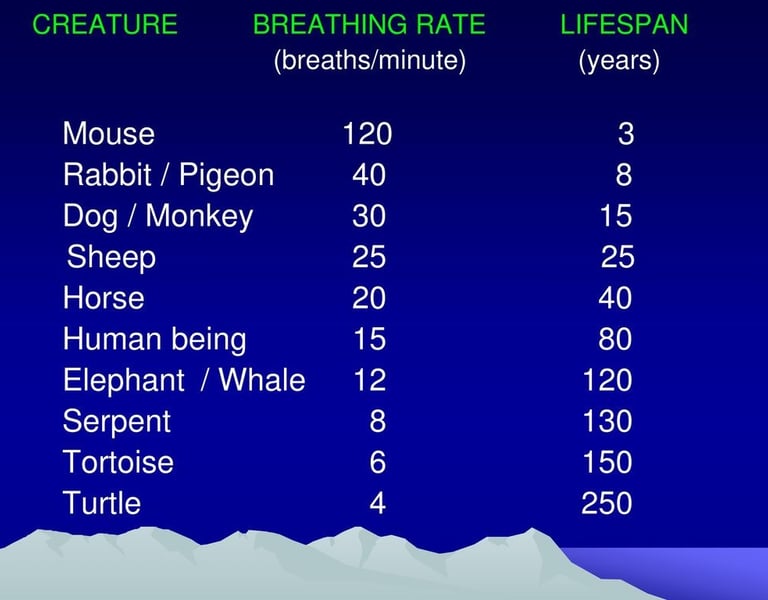
Additionally, the rate of breathing is directly correlated to the lifespan, which means your rate of breathing is killing you. The higher your breathing rate, the shorter your lifespan. Also, the breathing rate is directly correlated to the emotional state and the awakening of the human being.
Creature vs Breathing rate vs Lifespan
The Physiology of Inner Peace
Every emotion is physiological. When you’re calm, your breathing is slow and deep; your body enters parasympathetic mode — the state of healing and restoration.
When you’re stressed, the breath becomes short, irregular, and rapid, activating the sympathetic nervous system, the “fight or flight” mode.
But here’s the secret most people miss: The relationship between breath and emotion is bidirectional.
You don’t only breathe differently because you’re angry or anxious, you feel angry or anxious because you’re breathing in a certain way.
Change the breath, and you literally change the chemistry of your body:
Slow, deep breathing increases vagus nerve tone, calming the heart and mind.
Diaphragmatic breathing improves oxygen exchange and lowers cortisol (the stress hormone).
Coherent breathing (about 5–6 breaths per minute) synchronizes heart rhythms, brain waves, and emotional stability.
Science confirms what ancient wisdom knew: Breathing is the bridge between body and mind. It is the one physiological process we can consciously control that directly rewires our emotional patterns.
Breathing and the Energy of Life
If emotion means “energy in motion,” then breathing is how we move that energy.
When we suppress emotions, we unconsciously restrict our breath. The chest tightens. The diaphragm locks. The body stores unexpressed tension as muscle memory. Over time, these blocked emotions distort posture, drain vitality, and create physical illness.
Breath is energy. Every inhale draws in life force (prana, chi); every exhale releases stagnation.
When we breathe consciously, we circulate this energy instead of trapping it in old emotional loops.
That’s why deep breathwork sessions can make people cry, laugh, or shake because repressed emotions finally move. The breath frees what words cannot reach. It clears the energetic residue of past pain so that new emotional frequencies like peace, joy, and courage can emerge.
Your breath is your first therapist. Before you analyze, fix, or resist your emotions, breathe through them. Each conscious inhale says, I allow life to move through me. Each complete exhale whispers, I am safe to let go.
How Breath Shapes Your Mind and Circumstances
Your outer life mirrors your inner rhythm. If your inner rhythm is chaotic, rushed, or tight, your circumstances will often reflect that same tension: unstable finances, strained relationships, constant pressure, lack of clarity.
But when your breathing becomes steady, your thoughts begin to align.
Clarity returns. Creativity awakens. You start responding instead of reacting.
Think of breathing as your internal frequency tuner. When you are tense and shallow-breathing, your energy vibrates at survival frequencies — fear, worry, control.
When your breath deepens and slows, you shift into creation frequencies like gratitude, trust, and flow.
You attract what resonates with your energy. And your breath decides what energy you’re transmitting every second.
“You don’t manifest what you want. You manifest who you are. And who you are is revealed in how you breathe.”
The Breathing Identity: Who Are You Without the Tension?
Every breath you take is a statement of identity. When you breathe shallowly, you reinforce the story that you must survive, prove, and protect yourself. When you breathe fully, you declare that you are safe, worthy, and free to receive life.
The way you breathe reveals what you believe about yourself. Ask yourself:
Do I inhale like someone who deserves abundance, or like someone afraid to take too much?
Do I exhale like someone at peace, or like someone holding onto control?
Your breathing patterns reflect your inner programming. To change your life, you must reprogram your breath, because it’s the most direct route to reprogramming your subconscious identity.
When you deepen your breath, you expand your self-concept. You stop living as the limited “you” who reacts to the world, and start breathing as the creator who shapes it.
From Survival to Creation
Most people breathe as if they’re running from life. Their breathing is a series of micro-panics — a constant readiness for danger that never comes. This is the legacy of trauma, modern stress, and emotional repression.
But when you reclaim your breath, you move from survival to creation. In survival, you hold your breath. In creation, you release it.
When you breathe fully, you send a signal to your nervous system: I am safe now. It’s okay to create, love, rest, and receive.
You can’t create wealth, love, or health from a nervous system stuck in survival. But you can breathe your way into a new emotional reality, and that new inner reality magnetically attracts new circumstances.
Every deep breath is a rebellion against fear, and every calm exhale is a declaration of freedom.
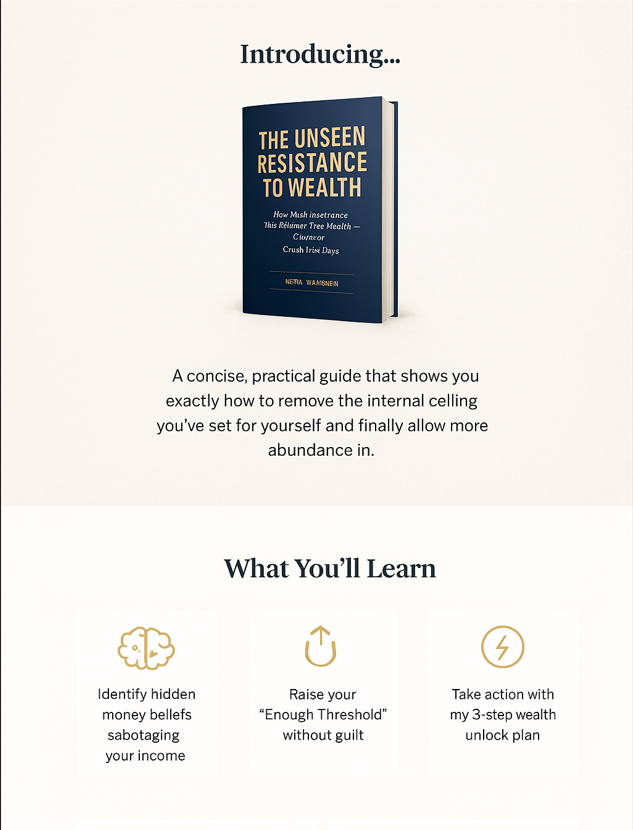
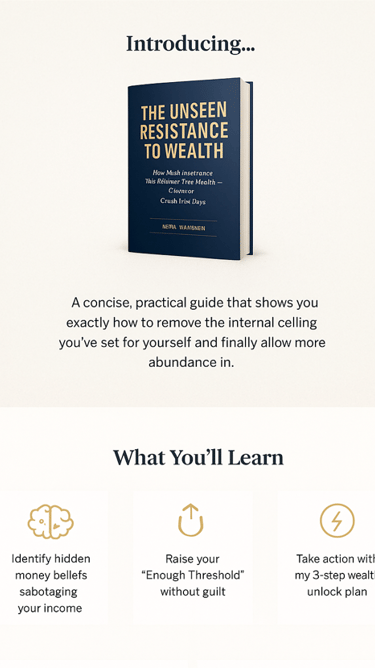
This is why I wrote my eBook: to expose the subconscious emotional and psychological blocks that trap people in money limitation, fear, identity sabotage, and emotional paralysis.
Until these blocks are removed:
Success feels forced
Wealth feels unreachable
Power feels unstable
Consistency feels exhausting
When they are removed:
Confidence becomes natural
Growth accelerates
People respond to you differently, and it feels amazing.
Money feels allowed
You exercise self-esteem and self-confidence.
You feel the freedom of decision, of choice.
You take care of yourself internally and intentionally.
You finally have the resources for your wildest experiences.
A New Relationship with Life
To breathe consciously is to live consciously. It’s not about mastering techniques — it’s about remembering who you are before fear began to shape your rhythm.
The breath invites you to return to simplicity, to the sacred now. In every moment, it whispers: “Slow down. You are safe. You are alive. You are enough.”
When you begin to breathe this truth into your cells, life transforms. You speak differently. You love differently. You think differently. And slowly, your outer world adjusts to match your new inner vibration.
The breath becomes the link between who you were and who you’re becoming.
Conclusion: The Breath of Destiny
The greatest change you can make in your life begins not with action, but with a single conscious breath.
Because before you can change your circumstances, you must change the frequency that attracts them, and that frequency is your emotional rhythm.
Breathe deeply enough, and you’ll feel the shift: the anxiety softens, the thoughts quiet, the heart expands.
That’s not just relaxation. That’s transformation. It’s your spirit remembering its natural state.
You were never meant to live disconnected from your own life force. The breath has always been calling you home.
So pause.
Inhale slowly, like you’re welcoming a new reality.
Exhale completely, like you’re releasing the old one.
And remember that you are one breath away from peace, one breath away from clarity, one breath away from a better life.
Related articles:
Charisma, Character, and Personal Magnetism: Which One Do You Need?
I Thought Working Hard Was Hard — Until I Started Feeling My Feelings and Being Present
Would You Ask Your Worst Enemy for Help to Move Towards Your Goals?
7 Lessons from Wealthy People on Handling Failure with their Self-Concept
The Roadmap to Wealth and Fulfillment: Mastering Polarity, Awareness, and Inner Battles
The Wealth Gap No One Talks About: Why Identity, Not Hard Work, Creates Millionaires
Why Your Self-Concept is Your Net Worth: The Hidden Psychology of Wealth Creation
How I Broke 13 Years of Money Blocks (And Why Most People Never Will)
theworld@inwithin.me
© 2025. All rights reserved.