Your Self-concept Generates Everything: Wealth, Abundance, Love, Relationships...

3 Things Preventing You From Achieving Your Vision
Your vision is not the problem. None of them is laziness, discipline, or strategy. They are encoded in your body.
Tal
5/19/20263 min read


You have the vision. You have had it for years — specific, vivid, persistent. It does not feel like fantasy. It feels like something that belongs to you, something that has been waiting with the particular patience of things that know they are real.
And you are still not there. The gap between where you are and where the vision lives is not closing the way discipline and strategy promised it would.
The problem is not your plan. It is not your work ethic. It is not even your circumstances. Psychology identifies three specific blockers operating below the level of strategy — and until they are addressed directly, no amount of planning will move the needle far enough.
1. The Childhood Dream You Never Grieved
Before the vision you currently hold, there was an earlier one; maybe the one on which you built everything else. Something you wanted before the world had opinions about it, before someone explained why it was unrealistic, before a specific failure made reaching feel dangerous, before you learned to want things within a more manageable radius.
That earlier dream did not disappear when you stopped talking about it. It went underground. And underground dreams do not simply wait quietly. They create interference — a low-frequency static between who you currently are and who you are trying to become, a subconscious loyalty to the version of yourself that got left behind.
Childhood trauma sensitizes threat-detection systems, leading to persistent hypervigilance, and among the cognitive processes most vulnerable to these trauma-induced alterations, mental imagery is particularly susceptible, due to its fundamental dependence on integrated bodily and sensory representations. Mental imagery is not decoration. It is the neurological mechanism through which the brain simulates future possibilities and motivates the body toward them. When early wounds disrupt the capacity to generate vivid, stable images of the future, the vision loses its traction — not because it is wrong, but because the internal machinery required to pursue it is compromised at the root.
Grieving the childhood dream is not nostalgia. It is clearing the frequency so the current vision can transmit without static.
2. The Unhealed Emotion Running the Operation
Every unprocessed emotional experience from your past is not stored in memory. It is stored in behavior. In the specific decisions you make when opportunity arrives. In the ceiling you accept without examining. In the moment you were almost there — and something in you found a reason to stop.
Unhealed emotions do not block your vision by making you sad. They block it by making certain outcomes feel unconsciously dangerous — too visible, too successful, too far from the identity that was formed in pain. The nervous system, which prioritizes safety above all else, reads expansion as threat when expansion was historically followed by punishment, withdrawal, or loss.
Emotion dysregulation is a key mechanism explaining associations between early experience and later psychological functioning — and it is in middle childhood, otherwise known as the forgotten years, that children develop their sense of self and rationalize their emotions. What was rationalized in those forgotten years — about what you deserve, what is possible, what happens to people like you when they reach too far — is still running the calculation.
3. A Tensed Nervous System That Cannot Access the Future
This is the most overlooked blocker and the most structural. A dysregulated nervous system is not simply a stress problem. It is a perception problem.
The stories about who we are and how the world works originate in our autonomic state, are sent through autonomic pathways from the body to the brain, and then translated by the brain into the beliefs that guide our daily living. The mind narrates what the nervous system knows. The story follows the state.
A nervous system locked in fight-or-flight cannot access the ventral vagal state — the specific physiological condition in which creative thinking, long-term planning, and genuine motivation become available. When the nervous system shifts into fight-or-flight mode, we become more reactive, defensive, and less capable of clear thinking — hindering decision-making and contributing to feelings of burnout.
You cannot think your way to your vision from a dysregulated body. The vision requires a nervous system that feels safe enough to believe the future is real and worth moving toward. Safety is not a luxury. It is the neurological prerequisite for everything the vision requires.
What connects all three blockers is the same invisible thread — the body carrying what the mind has tried to resolve through strategy alone.
There is a version of this same pattern operating in your relationship with wealth. The unhealed emotion that makes success feel dangerous. The tensed nervous system that self-sabotages at the threshold of enough. The childhood story still decides how much you are permitted to receive.
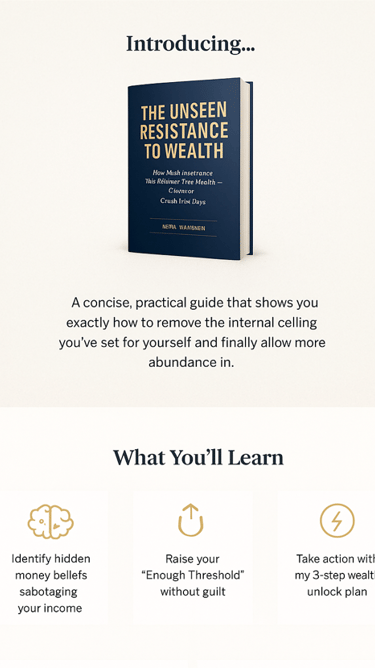
The Unseen Resistance To Wealth — How Much Is Too Much For You? names that pattern with the same precision this article brings to vision — and goes further, into the specific internal architecture that keeps capable people financially stuck regardless of opportunity. If the vision includes financial freedom, start there. [Link]
The vision is not waiting for a better strategy. It is waiting for the person who is safe enough, healed enough, and regulated enough to finally let it arrive.

Related articles:
Charisma, Character, and Personal Magnetism: Which One Do You Need?
Inside Out 2: Unlocking Levels of Consciousness
Would You Ask Your Worst Enemy for Help to Move Towards Your Goals?
7 Lessons from Wealthy People on Handling Failure with their Self-Concept
Julius Caesar's Magnetic Gaze: Power & Influence
Lazy but Ambitious: The Hidden Psychological Pattern Sabotaging Intelligent People
The Wealth Gap No One Talks About: Why Identity, Not Hard Work, Creates Millionaires
Why Your Self-Concept is Your Net Worth: The Hidden Psychology of Wealth Creation
How I Broke 13 Years of Money Blocks (And Why Most People Never Will)
theworld@inwithin.me
© 2025. All rights reserved.