Your Self-concept Generates Everything: Wealth, Abundance, Love, Relationships...
Being in Power Is an Illusion And Being Close to Power Is a Dangerous Illusion
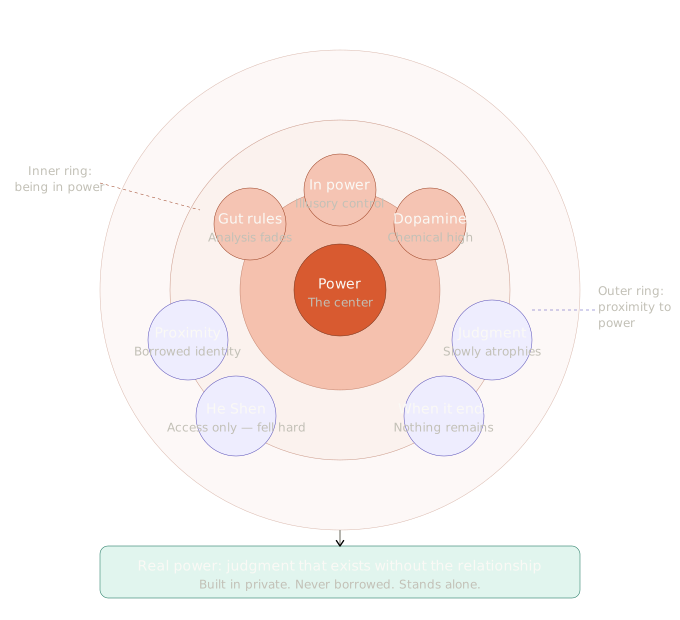
Most people chase power or orbit those who have it. Both are traps. Science shows that power creates an illusion of control, and proximity to it creates something far more dangerous: borrowed identity. Here's what happens to your mind when you get too close to the flame.
Tal
3/24/20263 min read


History doesn't just remember the emperors who fell. It remembers the men beside them; the ones who whispered in the right ear, signed off on the wrong decree, and woke up one morning stripped of everything, wondering how they got there.
They got there by mistaking proximity for power and being more powerful than they actually are.
The Illusion Inside the Chair
A study published in Psychological Science found that power can literally "go to one's head," causing individuals to believe they have more personal control over outcomes than they actually do. The powerful don't just feel more capable. They believe, neurologically, that outcomes beyond their reach are still within their control.
Research shows that the sense of power activates the same left frontal cortex that governs dopamine, the same reward circuitry that produces a high from drugs like cocaine. Blogger Power isn't just social. It's a chemical state. And like any drug, it distorts perception.
A 2024 study published in PLoS One found that power increases overconfidence and illusory thinking, specifically, the tendency to believe one understands the world in more depth and coherence than one actually does.
This is why powerful people don't just make mistakes. They make certain mistakes. They act on instinct, dismiss contradictory data, and confuse their position with their intelligence. The illusion of personal control might be one way power often leads to its own demise.
Being in power, in other words, is the beginning of a very convincing lie you tell yourself.
The Even Darker Illusion: Being Close to Power
If power corrupts perception, proximity to power does something subtler and more personal. It corrupts identity.
When you stand in the shadow of someone powerful, their heat begins to feel like yours. Their access becomes your access. Their reputation becomes your borrowed currency. You stop building your own foundation and start leaning on theirs. And the terrifying part? You don't notice it happening.
Consider He Shen, the trusted imperial adviser of Emperor Qianlong in Qing Dynasty China. He rose through the ranks due to intelligence, charm, and political acumen, catching the emperor's attention and becoming his most trusted confidant. He accumulated staggering wealth and influence. Then the emperor died. He Shen was arrested, found guilty, stripped of rank and titles, his assets seized, and executed, his legacy reduced to a cautionary tale about the dangers of proximity and unchecked power.
He didn't lose power. He never had it. He only had access.
The Psychology of the Inner Circle
Research published in International Organization found that the sense of power activates intuitive thinking, a reliance on gut feelings, heuristics, and prior beliefs, rather than deliberate analysis. For those in power, this produces overconfidence. For those near power, it produces something else: a kind of borrowed certainty, where the proximity itself becomes a substitute for genuine capability.
People close to power stop developing independent judgment because they never have to. The powerful person decides. They execute. Over time, they lose the ability to know what they actually think or what they're actually worth — outside of that relationship.
When the powerful person exits the stage, the inner-circle member is left with a skill set built entirely around someone else's vision and an identity entirely borrowed from someone else's name.
The Insight That Changes Everything
Real power — the kind that doesn't collapse when the relationship ends — is built in private. It's the quiet accumulation of your own judgment, your own perspective, your own credibility that exists independently of who you know.
The question isn't "Am I close to someone powerful?"
The question is: "If that person disappeared tomorrow, what would remain of me?"
If the answer is unclear, you are not building power. You are renting someone else's.
The most dangerous place to stand is not outside power. It's beside it — close enough to feel its warmth, far enough to never truly have your own.
Related articles:
Charisma, Character, and Personal Magnetism: Which One Do You Need?
Inside Out 2: Unlocking Levels of Consciousness
Would You Ask Your Worst Enemy for Help to Move Towards Your Goals?
7 Lessons from Wealthy People on Handling Failure with their Self-Concept
Julius Caesar's Magnetic Gaze: Power & Influence
Lazy but Ambitious: The Hidden Psychological Pattern Sabotaging Intelligent People
The Wealth Gap No One Talks About: Why Identity, Not Hard Work, Creates Millionaires
Why Your Self-Concept is Your Net Worth: The Hidden Psychology of Wealth Creation
How I Broke 13 Years of Money Blocks (And Why Most People Never Will)
theworld@inwithin.me
© 2025. All rights reserved.