Your Self-concept Generates Everything: Wealth, Abundance, Love, Relationships...
"Can I Be Honest With You"? The Narcissistic Question Disguised as a Virtuous One
"Can I be honest with you?" sounds like a gift. It is a trap. Carl Jung called it narcissistic projection. Machiavelli called it flattery wearing virtue's face. Here's what it's really doing to you — and how to stop flinching when you hear it.
Tal
4/8/20264 min read


The moment someone asks your permission to be honest, honesty has already left the room.
Notice what the question does. It does not deliver truth. It announces it — theatrically, with a runway, with the implicit suggestion that what follows is rare, courageous, compassionate, and generous. It frames the speaker as someone willing to sacrifice comfort for your benefit. It positions you, before a single word of content, as someone who needs to receive this bravely.
That choreography is not honesty. It is power in a robe.
In The Prince, Machiavelli wrote that the appearance of virtue is more politically useful than virtue itself — that a ruler need not possess all the good qualities, but must seem to possess them. He understood, five centuries before psychology formalized it, that the most effective manipulation wears the face of the thing it is destroying.
He also wrote: “There is no other way to guard yourself against flattery than by making men understand that telling you the truth will not offend you.” Read that slowly.
The antidote to manipulation disguised as honesty is a self so grounded that it no longer needs the permission ritual at all. A person rooted in themselves does not ask to be honest. They simply are.
The question “Can I be honest with you?” is, in Machiavellian terms, flattery in reverse. It flatters the speaker with the costume of courage. It flatters you with the illusion of being trusted. And in that double flattery, it extracts something from both parties — your guard and your gravity.
The person who announces their honesty is, most often, projecting their own relationship with truth onto you. They are not being honest. They are performing honesty because somewhere in their shadow — Jung’s term for the unconscious repository of what we refuse to own — there is a self that knows it cannot simply be truthful without ceremony.
Jung wrote: “Everyone carries a shadow, and the less it is embodied in the individual’s conscious life, the blacker and denser it is.”
The ritual question is the shadow speaking. It needs the drama because the truth, alone, is not enough for it. The truth must come with an audience, a frame, a moment. And you are cast as the grateful recipient.
Jung also observed that “no progress or growth is possible until the shadow is adequately confronted — and confronting means more than merely knowing about it.”
The person asking your permission has not confronted their own shadow. They have dressed it in virtue’s clothing and sent it out to do work on their behalf.
What It Is Actually Doing to You?
If you are psychologically weak — and many people are, because weakness is not character, it is conditioning — the question lands as a threat with a smile. It activates your people-pleasing reflex. It makes you brace. It makes you say “of course” when your body already knows you should say nothing.
“Psychology Today” notes that narcissists, aware that other people experience genuine guilt, use it as a tool of manipulation — they cannot feel true guilt themselves, but they are skilled at producing it in others.
The question is a guilt preloader. Before the content arrives, it has already established that you are the kind of person who welcomes hard truths — meaning any pushback you offer afterward makes you a liar about your own character.
This is precise. And your flinching is the proof it works.
The Stoic Response
Machiavelli’s advice was simple and cold: “Men will always be out to trick you unless you force them to be honest.” Force, here, does not mean aggression. It means the force of an interior that does not negotiate its own stability.
Jung’s advice was harder: make the unconscious conscious. Recognize the ritual for what it is — not a gift of truth but an architecture of dominance — and refuse to live inside its frame.
The response to “Can I be honest with you?” is not defensiveness. It is not warmth. It is a steady, unremarkable:
“You don’t need my permission.”
“You can say it, I will decide what to do with it.”
"I will evaluate it, so go ahead."
“You have already decided to do so anyway.”
No drama. No runway offered.
That answers collapse the theater. It removes the costume. And it returns both parties to the only ground that matters: what is actually true, spoken plainly, without needing anyone’s applause. And more importantly, makes the speaker accountable.
That is where the psychologically strong live. Not above the question — but entirely outside its jurisdiction.
This is an external manipulation. What to do against the mental manipulation that you identify with?
Every time you shrink your ambition to stay “reasonable,”
You betray yourself.
Every time you downplay your vision to stay acceptable,
You betray yourself.
And betrayal repeated long enough feels like destiny. It is not.
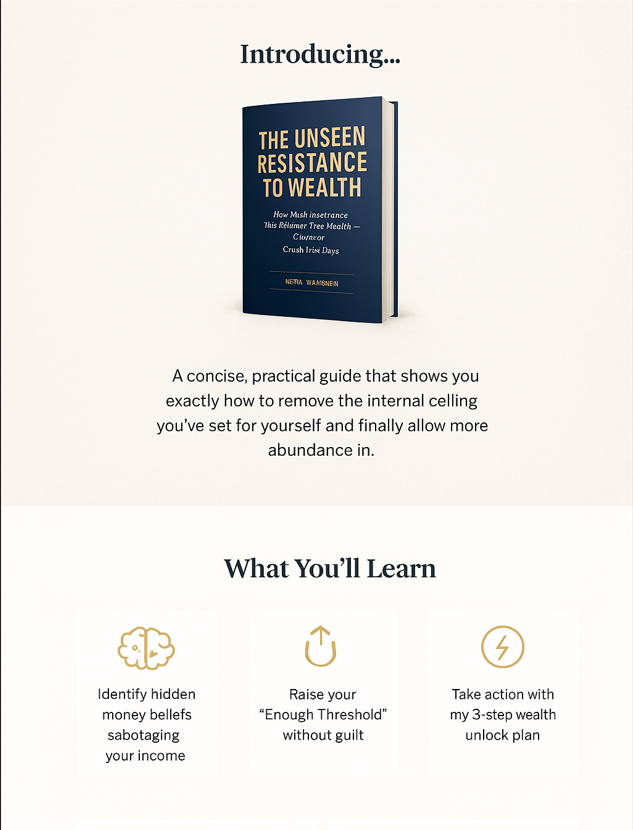
“The Unseen Resistance To Wealth” by Brooke Davis breaks these mental blocks.
Related articles:
Charisma, Character, and Personal Magnetism: Which One Do You Need?
Inside Out 2: Unlocking Levels of Consciousness
Would You Ask Your Worst Enemy for Help to Move Towards Your Goals?
7 Lessons from Wealthy People on Handling Failure with their Self-Concept
Julius Caesar's Magnetic Gaze: Power & Influence
Lazy but Ambitious: The Hidden Psychological Pattern Sabotaging Intelligent People
The Wealth Gap No One Talks About: Why Identity, Not Hard Work, Creates Millionaires
Why Your Self-Concept is Your Net Worth: The Hidden Psychology of Wealth Creation
How I Broke 13 Years of Money Blocks (And Why Most People Never Will)
theworld@inwithin.me
© 2025. All rights reserved.