Your Self-concept Generates Everything: Wealth, Abundance, Love, Relationships...
Grief Has a Biology. And Skipping It Has Consequences Nobody Warned You About.
On the neuroscience of unprocessed loss, the body's specific grief protocol, and why time alone does not heal anything.
Tal
8/5/20263 min read


Nobody told you grief had a protocol.
They told you time heals. They told you to stay strong. They handed you the five stages like a tidy checklist and implied that working through them efficiently was the goal. They told you to keep busy, keep moving, keep your chin up, keep going — because the opposite, which is stopping and actually feeling the full weight of what was lost, seemed to everyone involved like the most dangerous possible option.
It turns out the stopping was the protocol. And skipping it has a neurological price tag.
Grief profoundly affects psychological and biological systems simultaneously. Hormonal dysregulation — including elevated oxytocin and cortisol levels — plays a significant role in the physiological response to grief. Neural alterations are observed in key brain regions associated with memory, emotion regulation, and attachment, including the amygdala, hippocampus, and prefrontal cortex. Epigenetic modifications of stress-related genes further contribute to individual variability in grief responses.
This is not a metaphor for sadness. This is a description of a biological process that, when activated by loss, requires specific neurological work to complete. The brain, when it loses something it was deeply attached to, must update its predictive model of the world — the deeply encoded expectation that the person, the relationship, the version of life will still be there. Our gone-but-also-everlasting model emphasizes that grieving may be a form of learning, requiring time and experiential feedback. Complications such as avoidance, rumination, and stress-induced hippocampal atrophy may develop after loss and create functional or structural mechanisms predicting prolonged grief disorder.
Hippocampal atrophy. From avoided grief. The brain region responsible for memory formation, emotional regulation, and spatial navigation — physically altered by the decision not to grieve.
This is the consequence nobody warns you about when they tell you to stay strong. Grief avoided does not leave when the acute phase passes. It becomes a permanent low-grade biological disruption — elevated cortisol, impaired immune function, disturbed sleep, reduced cognitive clarity, a generalized emotional numbness that people mistake for healing because it hurts less than the original pain. It is not healing. It is freezing. The biological process has stalled, and the body is now carrying the weight of an incomplete protocol.
The cruel irony is that the avoidance strategies feel adaptive in the short term because they genuinely reduce acute pain. Staying busy works. Throwing yourself into work works. Deciding to be fine works — for a while. And then it stops working, and the grief that was never processed arrives wearing other names: depression, anxiety, inexplicable anger, the inability to fully attach to anything new because some part of the system never released the old.
Grief is not weakness. It is neurological maintenance. The brain updating its map after a territory has changed. The work of learning — on the deepest biological level — that the world is now different from what it was, and that existing within that difference is possible.
The protocol is not complicated. It requires presence, permission, and time. Presence with the actual feeling rather than its management. Permission to not be okay for long enough that okay eventually becomes genuine rather than performed. Time that is genuinely given to the process rather than stolen from it.
The body knows how to grieve. It was designed for it. The only thing that makes grief pathological is the sustained, culturally endorsed decision to refuse it.
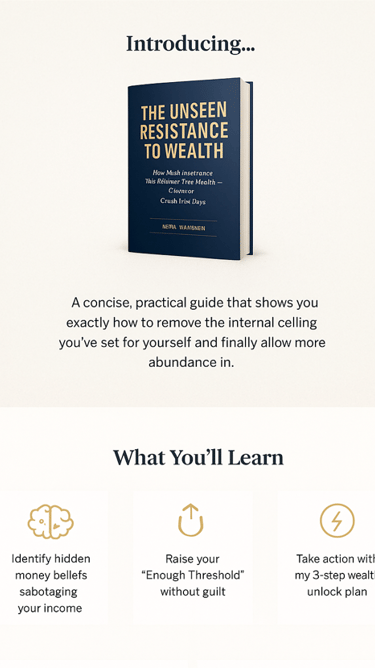
The Unseen Resistance To Wealth — How Much Is Too Much For You? includes the grief that most people carry about money — losses never acknowledged, opportunities mourned but never processed, the specific unresolved sadness of a person who has given their best years to financial struggle and never stopped to grieve what that cost. Some wealth resistance is not fear. It is unprocessed loss.

Related articles:
Charisma, Character, and Personal Magnetism: Which One Do You Need?
Inside Out 2: Unlocking Levels of Consciousness
Would You Ask Your Worst Enemy for Help to Move Towards Your Goals?
7 Lessons from Wealthy People on Handling Failure with their Self-Concept
Julius Caesar's Magnetic Gaze: Power & Influence
Lazy but Ambitious: The Hidden Psychological Pattern Sabotaging Intelligent People
The Wealth Gap No One Talks About: Why Identity, Not Hard Work, Creates Millionaires
Why Your Self-Concept is Your Net Worth: The Hidden Psychology of Wealth Creation
How I Broke 13 Years of Money Blocks (And Why Most People Never Will)
theworld@inwithin.me
© 2025. All rights reserved.