Your Self-concept Generates Everything: Wealth, Abundance, Love, Relationships...
How Can Someone So Broke Be Unable to Focus on the One Thing That Could Save Them?
Why being broke makes it impossible to focus on your burning desire?
Tal
7/24/20263 min read


The cruelest irony of financial scarcity is this: the moment you need your mind the most — clear, creative, forward-thinking, fully available to the burning desire that could change everything — is precisely the moment your mind becomes least available to you.
This is not weakness. It is not lack of discipline. It is not the universe testing your commitment, but neuroscience. And understanding it is the first step toward escaping it.
The Physical Reality
Harvard economist Sendhil Mullainathan and Princeton behavioral scientist Eldar Shafir spent years studying what poverty actually does to the brain, and the finding that emerged from their research should permanently end the conversation about why broke people cannot simply focus on their passion and execute.
Scarcity imposes a bandwidth tax: it occupies cognitive resources with the immediate scarcity problem, leaving less available for everything else. This explains why people make worse financial decisions when they are poor: not because of character flaws or lack of willpower, but because financial stress itself reduces the cognitive resources required for good financial decision-making.
The brain has a finite cognitive bandwidth — the total mental resource available for thinking, planning, self-control, and creative problem-solving. When financial scarcity enters, it does not simply add one worry to the list. It colonizes the bandwidth. It moves in permanently, running continuously in the background of every waking moment, consuming the exact cognitive fuel that the burning desire requires to become something real.
Scarcity compels people to focus their attention and allocate their cognitive resources to address immediate and pressing financial issues, leaving individuals with fewer available cognitive resources for actions that could improve their financial situation in the long run.
The vision is still there. The desire is still burning. But the mind that would execute it is running on emergency power — managing the immediate crisis of not enough while the long-term possibility sits waiting, untouched, for a bandwidth that never quite becomes available.
The Metaphysical Reality
Beneath the neuroscience lives something older and equally precise.
Every emotional state carries a frequency — a vibrational quality that determines what the person in that state can perceive, attract, and access. The frequency of financial scarcity is one of the densest human experiences available: it generates fear, shame, contraction, and the specific tunnel vision of a consciousness focused entirely on survival.
Desire — burning desire, the kind that changes lives — operates at an entirely different frequency. It requires expansion, openness, the felt sense that the future is real and worth moving toward. It requires a nervous system that feels safe enough to imagine beyond the present moment.
Scarcity and vision cannot fully coexist in the same frequency. The first collapses inward. The second reaches outward. The person in survival cannot simultaneously inhabit the consciousness of creation — not because they lack the vision, but because the body carrying the vision is broadcasting a signal that pulls in the opposite direction.
The Emotional Reality
The most invisible dimension is the emotional one — specifically, the shame.
Financial scarcity in a world that equates net worth with self-worth produces a specific, corrosive shame that goes far beyond the practical problem of not having enough money. It produces the felt sense of being fundamentally insufficient — of being someone to whom the good things do not come, someone for whom desire itself is a form of delusion.
That shame does not simply make focus difficult. It makes the burning desire feel dangerous — because desire requires belief, and belief requires a self that feels worthy of what it is reaching for. The broke person who cannot focus on their vision is often not failing to see the vision. They are failing to believe, at the level of the body and the nervous system, that the vision is for someone like them.
This is the resistance nobody names. Not the external barrier — the money, the resources, the opportunity. The internal one. The deeply encoded conviction that abundance belongs to a different category of person — and the unconscious commitment to remaining in the category that feels familiar, even when familiar means broke.
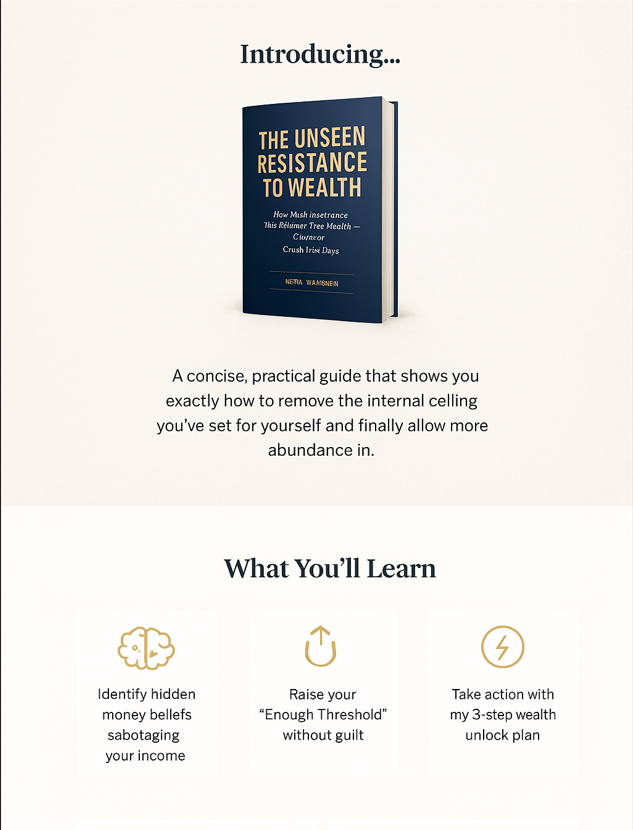
The Unseen Resistance To Wealth — How Much Is Too Much For You? was written precisely for this moment — the moment between the burning desire and the execution, where something invisible keeps intervening. It names the internal architecture that turns capable, visionary people into permanent beginners — and shows exactly where the ceiling was installed. [Link]
The desire is real. The vision is real. The bandwidth will return when the frequency changes — and the frequency changes when the resistance finally has a name.
Related articles:
Charisma, Character, and Personal Magnetism: Which One Do You Need?
Inside Out 2: Unlocking Levels of Consciousness
Would You Ask Your Worst Enemy for Help to Move Towards Your Goals?
7 Lessons from Wealthy People on Handling Failure with their Self-Concept
Julius Caesar's Magnetic Gaze: Power & Influence
Lazy but Ambitious: The Hidden Psychological Pattern Sabotaging Intelligent People
The Wealth Gap No One Talks About: Why Identity, Not Hard Work, Creates Millionaires
Why Your Self-Concept is Your Net Worth: The Hidden Psychology of Wealth Creation
How I Broke 13 Years of Money Blocks (And Why Most People Never Will)
theworld@inwithin.me
© 2025. All rights reserved.