Your Self-concept Generates Everything: Wealth, Abundance, Love, Relationships...
How to Dissolve a Limiting Belief in Less Than One Minute
A limiting belief is not a verdict. It is a prediction — one your brain formed, usually before you were seven years old, in response to an emotional experience that carried enough intensity for your nervous system to encode it as a rule about reality
Tal


The belief is not the problem.
The problem is that you have fused with it. You have confused a thought that arrived, was reinforced repeatedly until it felt permanent, and lodged itself into the operating system of your identity — you have confused that with truth, with fact, and with what is possible for you.
It is not the truth. It is just another neural pathway, like smiling back at a baby. That distinction is everything.
What a Limiting Belief Actually Is
Before you can dissolve something, you need to know what it is made of.
A limiting belief is not a verdict. It is a prediction — one your brain formed, usually before you were seven years old, in response to an emotional experience that carried enough intensity for your nervous system to encode it as a rule about reality.
During the first seven years of life, the brain operates primarily in theta-wave states — low-frequency, highly receptive, close to a hypnotic state. Children in this state do not filter; they absorb. They absorb the behavior and language of the adults around them and treat them as facts about the world and their place in it.
A child repeatedly told that money is always scarce does not conclude that this family has financial difficulties. They conclude I am someone for whom money does not come easily. A child whose emotional bids are consistently ignored does not conclude that this adult is unavailable. They conclude I am not interesting enough to be responded to.
These are not conscious decisions. They are the nervous system doing exactly what it was designed to do — scanning the environment, identifying patterns, forming predictions to guide future behavior. The tragedy is not that the mechanism exists. The tragedy is that the predictions formed at five years old are still running your decisions at thirty-five, at forty-five, at sixty — operating below the level of awareness, shaping what you reach for and what you do not, what feels possible and what does not even occur to you to try.
Limiting beliefs rarely appear suddenly. They develop gradually through repeated experiences, especially during emotionally significant moments. From a neuroscience perspective, the brain is constantly trying to predict outcomes. When a person experiences repeated disappointment, criticism, or failure, the brain forms associations designed to protect against future distress.
That is the mechanism. It was protective. It was intelligent. It is no longer serving you.
Why You Cannot Think Your Way Out
Here is where most advice on limiting beliefs fails — at the level of the method.
People are told to challenge their beliefs. To find counter-evidence. To replace negative thoughts with positive ones. To write affirmations, to visualize, to journal about where the belief came from, and to construct a rational argument against it.
These approaches have a fundamental problem. They engage the belief on its own terms. They treat it as a proposition requiring a counter-proposition, a logical claim requiring refutation. But the limiting belief is not primarily logical. It is emotional. It is somatic. It is held in the body as much as the mind. The nervous system that encoded it does not speak the language of rational argument. You cannot convince your amygdala with a persuasive essay.
The embodied nature of belief explains why purely intellectual approaches to changing beliefs often fail. If your nervous system has been conditioned to associate certain beliefs with safety and others with threat, your body will resist belief change even when your mind intellectually accepts new information.
The correct intervention is not to argue with the belief. It is to change your relationship to it.
Right now, part of you wants expansion. Another part wants safety. And safety keeps winning.
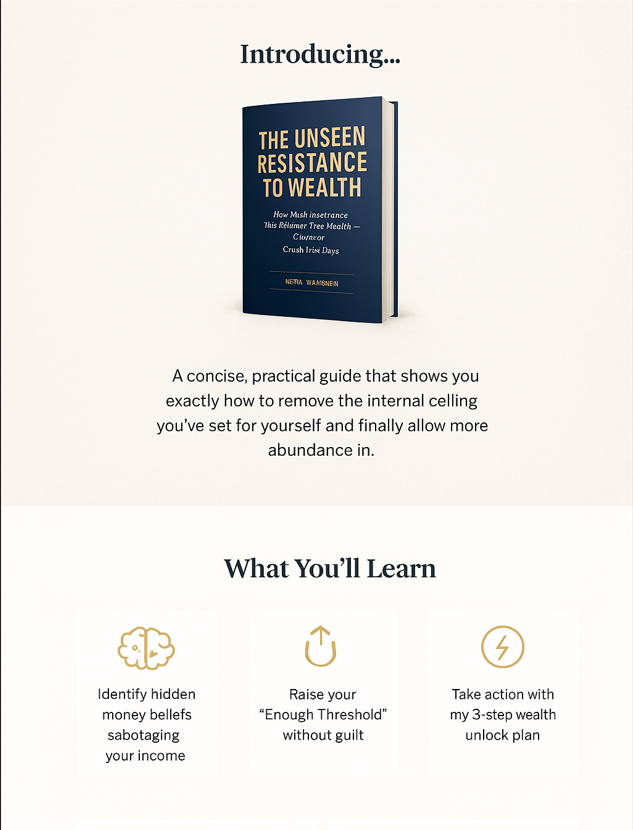
Brooke Davis, in his eBook " The Unseen Resistance To Wealth " exposes the hidden contracts you made with limiting beliefs — so you can finally stop sabotaging yourself quietly.
If you’re tired of fighting yourself, this is your next step.
The 60-Second Technique That Research Actually Validates
In 1916, psychologist Edward Titchener made an observation that behavioral science did not fully catch up with for nearly a century. He noted that when a word is repeated aloud rapidly, over and over again, it loses its literal meaning. The context required for language to carry its normal freight of significance dissolves. The word becomes sound. Form without content.
Researchers tested this principle directly on self-relevant negative beliefs — the precise category we are discussing. They compared this rapid repetition technique against distraction tasks and thought-control tasks. The cognitive defusion technique reduced both the discomfort and the believability of the negative thought more effectively than any other approach tested.
This is the technique. It is real. It takes under sixty seconds. Here is exactly how to use it.
Identify the specific limiting belief operating right now. Not the abstract category — the precise sentence your internal voice uses. I am not capable enough. People like me do not succeed at this level. I always find a way to sabotage myself. I am fundamentally too much, or not enough.
Take the core word — the word that carries the most weight, the one that lands the hardest. If the belief is I am not capable, the word is incapable. If the belief is that I do not deserve good things, the word is undeserving. If the belief is that I am invisible, the word is invisible.
Say that word aloud, rapidly, continuously, for thirty to forty-five seconds without stopping.
What happens is strange and important. Within roughly twenty seconds, the word begins to lose its charge. It becomes syllables. It becomes sound. The emotional grip — the sense that the word is pointing at something permanently true about you — begins to loosen. Not because you have argued against it. Because you have disrupted the context that gives it meaning. You have created what Acceptance and Commitment Therapy calls cognitive defusion: a gap between you as the observer and the thought as an object of observation, rather than a fact you are trapped inside.
What You Are Actually Doing
When you perform this technique, you are not suppressing the belief. You are not fighting it, reframing it, or trying to replace it with something more flattering. You are doing something more radical and more honest — you are demonstrating to your nervous system that the thought is a thought, a piece of language, a neural event, rather than a report about the permanent nature of reality.
This matters because the brain responds differently to believed facts and to observed thoughts. When you are fused with a belief, when I am not capable feels like looking at a mirror — the brain treats it as environmental data and organizes behavior accordingly. When you defuse from it, when you can observe, I am noticing a thought that I am not capable — the brain has room to act differently. The belief is still there. But it is no longer in the driver's seat.
Cognitive fusion occurs when people over-identify with their thoughts, leading to a strong emotional response and a narrowed behavioral repertoire. Cognitive defusion teaches people how to pay attention to the process of thinking, thereby reducing the negative effect of over-identification and allowing people to behave in more adaptive ways.
That is the shift. Not that the belief disappears. That it loses authority.
The Honest Caveat
This technique does not dissolve a belief the way surgery removes a tumor. It loosens it. It creates space. That space is where change lives — not in the moment of loosening itself, but in what you do with the space afterward. The actions you take inside that gap, the new experiences you create that contradict the old prediction, the gradual accumulation of evidence that the brain was wrong — that is the longer work, the deeper work, the work that actually rewires the pathway.
Neuroplasticity is real. When new experiences contradict existing beliefs, neural pathways gradually reorganize. But reorganization requires repetition, emotional salience, and time.
What you can do in sixty seconds is this: interrupt the authority of a belief long enough to act differently in the next moment. And in the next moment. Until the accumulation of different moments becomes a different life.
The belief is not who you are. It is what was decided about you, before you were old enough to disagree.
You are old enough now.
Disagree.
Related articles:
Charisma, Character, and Personal Magnetism: Which One Do You Need?
Inside Out 2: Unlocking Levels of Consciousness
Would You Ask Your Worst Enemy for Help to Move Towards Your Goals?
7 Lessons from Wealthy People on Handling Failure with their Self-Concept
Julius Caesar's Magnetic Gaze: Power & Influence
Lazy but Ambitious: The Hidden Psychological Pattern Sabotaging Intelligent People
The Wealth Gap No One Talks About: Why Identity, Not Hard Work, Creates Millionaires
Why Your Self-Concept is Your Net Worth: The Hidden Psychology of Wealth Creation
How I Broke 13 Years of Money Blocks (And Why Most People Never Will)
theworld@inwithin.me
© 2025. All rights reserved.