Your Self-concept Generates Everything: Wealth, Abundance, Love, Relationships...
If You Think Letting Go Is Easy, Release Your Facial Muscles for 24 Hours
Your Face Has Been Clenching Since Childhood: Facial muscles tense before the mind consciously registers stress.. What It Is Holding Will Surprise You. Letting go becomes the key
Tal
8/4/20264 min read


Go ahead. Try it right now.
Soften the jaw. Release the clench you did not know was there. Let the space between your back teeth open. Drop the tension around your eyes — the subtle squint you have been holding since the third email this morning. Unclench the corrugator, the little muscle between your brows that has been pulling them together since approximately 600 BC. Let your lips part slightly, your tongue drop from the roof of your mouth, your forehead smooth from whatever calculation it has been running all day silently.
Hold that for thirty seconds.
Notice what just happened. Not in your face — in your chest. In your breathing. In the strange, slightly vulnerable feeling of having released something you did not consciously decide to hold in the first place.
Now imagine doing that for twenty-four hours straight.
You cannot. And the reason you cannot is the most honest thing your body will ever tell you about yourself.
Throughout our lives, we make the same facial expressions over and over based on our personalities and habitual reactions. With repetition, chronic tension builds up in our facial muscles just like it does in muscles throughout the body. In the same way that chronic tension in our postural muscles can keep us stuck in a state of stress, chronic tension in our facial muscles can keep us stuck in the corresponding emotional state.
The face is not simply where emotions are displayed. It is where they are stored. The psychosomatic tradition — from Wilhelm Reich's concept of character armor to modern somatic psychology — has argued for decades that unresolved emotional experience does not simply disappear when we decline to feel it. It migrates. Into posture, into breath, and most densely into the face — the most innervated area of the body, the most directly wired to the emotional brain, the most continuously expressive and therefore the most continuously holding.
Research published in the Journal of Psychosomatic Research demonstrates that facial muscles tense in predictable patterns during stress, often before individuals report feeling stressed consciously. This phenomenon is called neuromuscular coupling — the direct pathway between psychological stress and physical muscle response.
Your face knows before you do. It registers the threat, the grief, the suppressed anger, the withheld response, and it contracts around it. And if the emotion never gets processed, the contraction never fully releases. It simply becomes the new resting position, the new normal. The face that people recognize as yours, not because it reflects who you are, but because it reflects what you have been carrying long enough for it to feel like who you are.
According to somatic psychology, facial muscles can hold emotional residue from unresolved stress or habitual thought patterns. A 2022 meta-analysis published in Nature Human Behaviour reviewed over fifty studies and confirmed that facial expressions can influence our feelings — suggesting that chronic tension in the facial muscles, especially those involved in frowning or clenching, may reinforce emotional stress over time.
This is the loop that makes the twenty-four-hour experiment so instructive. The unresolved emotion creates facial tension. The facial tension feeds back into the emotional state, reinforcing and perpetuating it. The person who has been holding grief in their jaw for three years is not simply carrying a physical habit. They are running a continuous neurological loop that keeps the grief metabolically active — present, influential, consuming — long after the conscious mind has decided to move on.
Letting go, it turns out, is not a decision. It is not a mindset shift or an act of will or a morning routine. It is a somatic event — something that happens in the body when the body finally feels safe enough to release what it was protecting you from having to feel all at once.
The brain does not just command the face — it listens to it. This is the facial feedback effect. More than forty muscles work in your face and around your eyes and jaw. They are unusual — most attach not bone to bone but straight into the skin, built purely to express state. When you are anxious, a predictable set contracts. Most of the day you do not notice. The tension has become the background.
The tension has become the background. That sentence deserves a full stop and a moment of honest sitting-with.
What if the chronic low-grade emotional state you have been living inside — the vague tension, the subtle guardedness, the persistent sense that something is being managed — is not your personality? What if it is simply what you have been holding for so long that it has become indistinguishable from your face?
There is a direct connection between what you hold in your face and what you hold in your life. The same neuromuscular pattern that keeps grief in your jaw keeps limitation in your vision. The same chronic contraction that says I am not safe enough to fully release in the body says I am not safe enough to fully receive in every domain of life — including wealth, including love, including the fullness of what you are actually capable of.
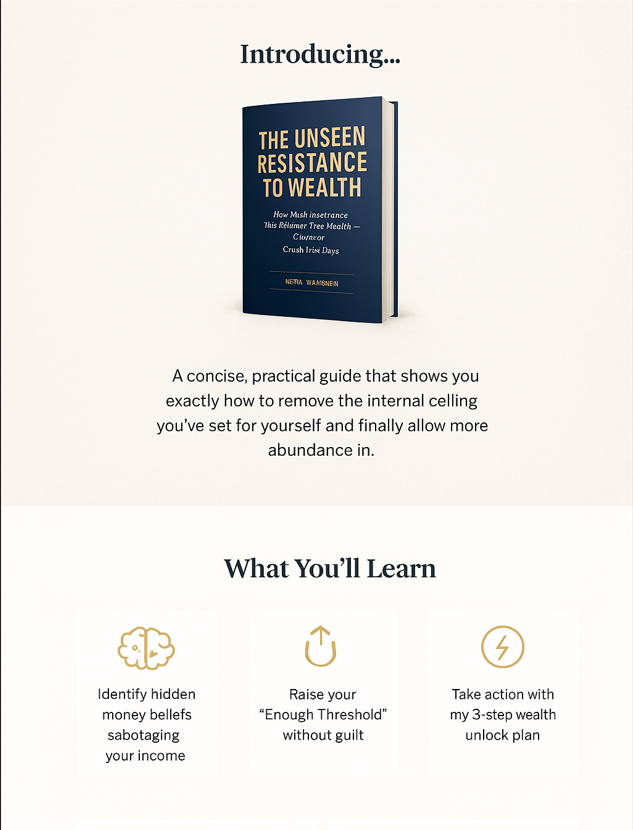
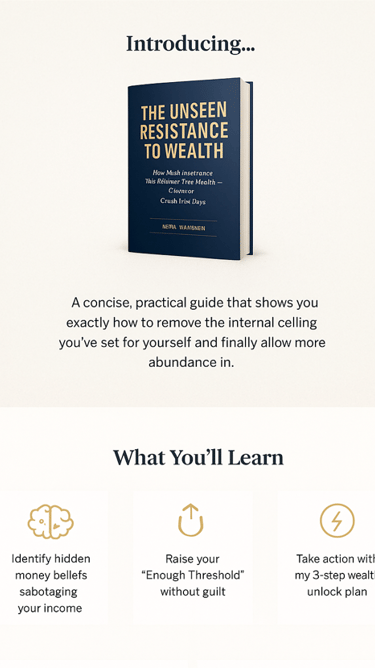
The Unseen Resistance To Wealth — How Much Is Too Much For You? addresses the body's holding patterns around abundance — the somatic, emotional, and psychological contractions that decide, below the level of conscious choice, how much good you are permitted to receive before something in you braces against it. The resistance is not in your strategy. It is in your body. It always has been.
Release your face. Notice what follows.
The letting go you have been calling a mindset problem has always been a body problem first.
Related articles:
Charisma, Character, and Personal Magnetism: Which One Do You Need?
Inside Out 2: Unlocking Levels of Consciousness
Would You Ask Your Worst Enemy for Help to Move Towards Your Goals?
7 Lessons from Wealthy People on Handling Failure with their Self-Concept
Julius Caesar's Magnetic Gaze: Power & Influence
Lazy but Ambitious: The Hidden Psychological Pattern Sabotaging Intelligent People
The Wealth Gap No One Talks About: Why Identity, Not Hard Work, Creates Millionaires
Why Your Self-Concept is Your Net Worth: The Hidden Psychology of Wealth Creation
How I Broke 13 Years of Money Blocks (And Why Most People Never Will)
theworld@inwithin.me
© 2025. All rights reserved.