Your Self-concept Generates Everything: Wealth, Abundance, Love, Relationships...
Neuroscience says Something Older and Faster Than Thought Quietly Runs Decisions
You think logic runs your decisions. Neuroscience disagrees — and the gap between what you think drives your choices and what actually does is where your entire life is being decided. The first thought in any sale
Tal
5/5/20263 min read


Can You Name the Emotion Behind Every Choice You Make?
You did not choose that job with your brain. You chose it with your nervous system — and then you built a rational explanation afterward and called it a decision.
This is not an insult. It is neuroscience. And until you understand it fully, you will keep believing you are the author of your choices while something older and faster than thought quietly runs the operation.
Here is what the research actually says. The emotional route is the first click in decision-making, especially in situations characterized by ambiguity, uncertainty, and risk, which is to say, in every situation that actually matters. The low-stakes, fully predictable choices are the ones logic handles adequately. Every significant crossroads in your life — the relationship, the career, the confrontation you had or avoided, the version of yourself you showed up as in that room — was navigated primarily by emotion, with logic arriving later to write the minutes.
Antonio Damasio spent decades studying patients with damage to the ventromedial prefrontal cortex — the brain region connecting emotional processing to decision-making. These patients retained full intelligence. Perfect reasoning capacity. And they became catastrophically bad at making decisions. Without access to emotional signals, they could generate options indefinitely but could not choose between them. The feeling, it turned out, was not the noise in the decision. It was the signal.
Emotions constitute potent, pervasive, and predictable drivers of decision-making. Potent. Pervasive. Predictable. Not occasional influences. The primary architecture.
So here is the self-awareness question that most people spend their entire lives not asking: can you name the specific emotion operating underneath each significant choice you make?
Not the reason you gave, but the emotion underneath the reason.
You did not stay in that relationship because you were committed. You stayed because leaving activated a fear you have been carrying since childhood — the specific fear of what your absence means about your worth. You did not take the safe career path because it was sensible.
You took it because ambition felt dangerous in a family where visibility was punished. Your brother was doing much better, so you took a different career because it would be like competition, and your mind told you, it was impossible to win.
You do not avoid conflict because you are a peaceful person. You avoid it because anger was never safe in the room where you grew up, and peace became the performance that kept you protected.
The reason sounds like logic. The emotion underneath it is the actual author.
This gap — between the stated reason and the emotional driver — is precisely where self-awareness lives or dies. Most people operate entirely in the stated reason. They can explain every choice they have ever made with complete internal consistency, and every explanation will be accurate at the surface level, and almost none of it will be the real answer.
Acknowledging emotions can enhance the efficacy of decision-making and promote better outcomes in personal and organizational contexts. Acknowledging — not suppressing, not overriding, not managing. Acknowledging. Naming. Making contact with the actual emotional content before the rational architecture buries it under a more acceptable explanation.
The practice is specific and uncomfortable. Before any significant decision, pause long enough to ask not what is the logical choice but what am I feeling right now, and what does this feeling want me to do? Then ask the harder question: is this feeling giving me accurate information about the present situation — or is it a very old feeling, from a very different situation, that has been misfiling itself as current intelligence for years?
You don’t live in a poor world. You live inside a poor perception.
And perception is powerful enough to make abundance feel distant, and struggle feel normal.
This eBook is not about making more. It’s about dissolving the prison you didn’t know you were maintaining.
Because once the decisions are aligned, reality follows.
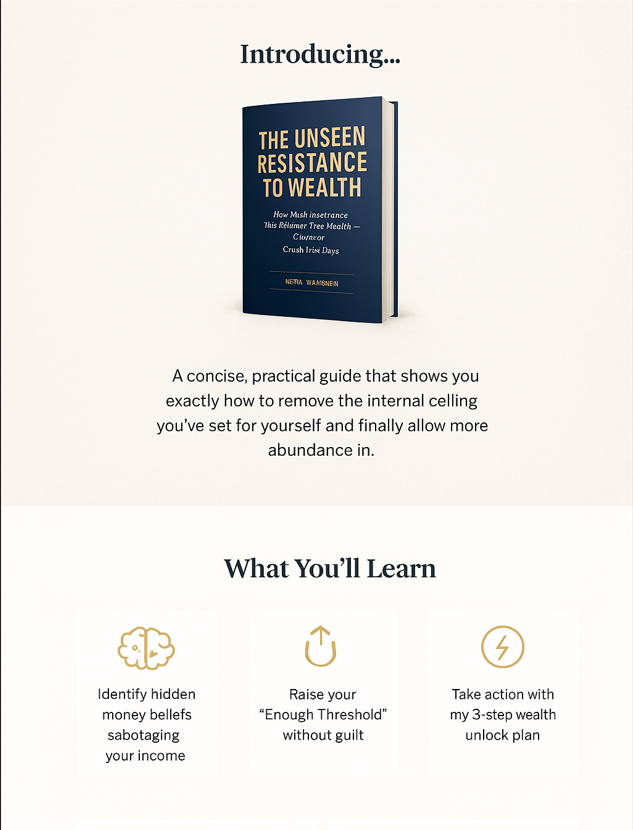
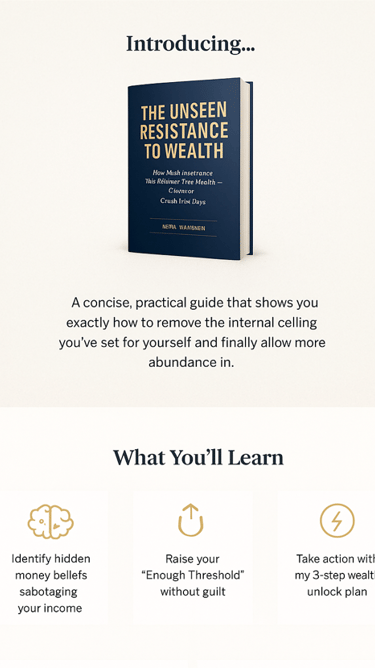
This is what Brooke Davis discusses in his eBook "The Unseen Resistance to Wealth" at a deeper level.
Your emotions are not your enemy. They are your most honest advisor. But an advisor giving advice from 1987 about a meeting happening today is not an advisor. It is a haunting.
Self-awareness is not knowing yourself in the abstract. It is catching the emotion before it becomes the decision — and asking whether, this time, you want to let it drive.
Related articles:
Charisma, Character, and Personal Magnetism: Which One Do You Need?
Inside Out 2: Unlocking Levels of Consciousness
Would You Ask Your Worst Enemy for Help to Move Towards Your Goals?
7 Lessons from Wealthy People on Handling Failure with their Self-Concept
Julius Caesar's Magnetic Gaze: Power & Influence
Lazy but Ambitious: The Hidden Psychological Pattern Sabotaging Intelligent People
The Wealth Gap No One Talks About: Why Identity, Not Hard Work, Creates Millionaires
Why Your Self-Concept is Your Net Worth: The Hidden Psychology of Wealth Creation
How I Broke 13 Years of Money Blocks (And Why Most People Never Will)
theworld@inwithin.me
© 2025. All rights reserved.