Your Self-concept Generates Everything: Wealth, Abundance, Love, Relationships...
Should I Cut Off My Parents Because of Trauma Inheritance?
27% of Americans are estranged from a family member. Trauma inheritance is real — epigenetics confirms it. But cutting off your parents may not break the cycle. Here's what the research actually says, and what you owe yourself to know before you decide.
Tal
4/10/20264 min read


The Cut-Off Question Nobody Answers Honestly
The question is not whether your parents hurt you. They probably did — and some of that hurt was not even theirs to give. It was inherited. Passed down through silences, survival responses, and nervous systems shaped long before you were born.
The question is whether distance from them heals what they transmitted — or whether the wound travels with you regardless.
What Trauma Inheritance Actually Is
Intergenerational trauma is not a metaphor. Research published in World Psychiatry confirms there is now converging evidence that offspring are affected by parental trauma exposures occurring before their birth — and possibly even prior to their conception.
The mechanisms are layered. Traumatic experiences can alter how genes are activated or deactivated — similar to a marginal note in a book — and some of these changes can be passed on to children. Trauma does not alter DNA itself, but it can guide gene expression in ways that affect stress responses, mental health, and physical health in the next generation.
Beyond epigenetics, the transmission is also behavioral and relational. The worldview created by traumatic experience can be inherited by children. Even young children detect and react to their parents’ anxiety cues. Studies of Holocaust survivors found that while many resisted talking to their children about their experiences, their worldview — that the world was a dangerous place where terrible things could happen at any time — affected their children’s outlook.
Your parents did not choose to give you this. In most cases, they do not even know they did. That is not absolution. It is context.
The Estrangement Epidemic
A five-year study, the Cornell Family Estrangement and Reconciliation Project, found that 27% of Americans are estranged from one or more family members. A Journal of Marriage and Family study found that 26% of young adults are estranged from their fathers, and 6% from their mothers.
This is not a fringe phenomenon. It is a generational shift in how people understand their obligation to the family system — and to themselves.
Research on people who have initiated estrangement shows mixed outcomes. Some report greater independence, autonomy, and personal agency. Others experience depression, decreased ability to self-regulate, and heightened physiological stress responses. Eighty percent reported some positive outcomes. But the impact on overall well-being is genuinely mixed.
This is the fact that the internet does not tell you when it says: cut them off, protect your peace.
What Cutting Off Does and Does Not Do
Here is what estrangement accomplishes: it removes the active source of harm from your daily life. If the relationship involves ongoing abuse — physical, psychological, sexual — distance is not optional. It is survival. Mayo Clinic psychologists confirm there are situations where cutting ties is necessary and healthy, particularly when the relationship involves harmful factors such as abuse or unwanted manipulation.
Here is what estrangement does not accomplish: it does not remove the trauma that was already transmitted. The epigenetic changes have already been made. The attachment patterns are already formed. The worldview is already installed. You carry those with you into every relationship, every workplace, every moment of fear or rage or shutdown — regardless of whether your parents are in your phone contacts.
One key to overcoming generational trauma is recognizing that the initial trauma remains unhealed. When one becomes aware of the trauma they carry, identifies its source, and gets help addressing it, then its intergenerational transfer can be halted.
The transfer stops with awareness and treatment. Not automatically with distance.
Something important to keep in mind: At a certain age, you are not a victim of your parents’ inheritance anymore. You are now wounding others through your trauma, whether close to your parent or not. And this without realizing.
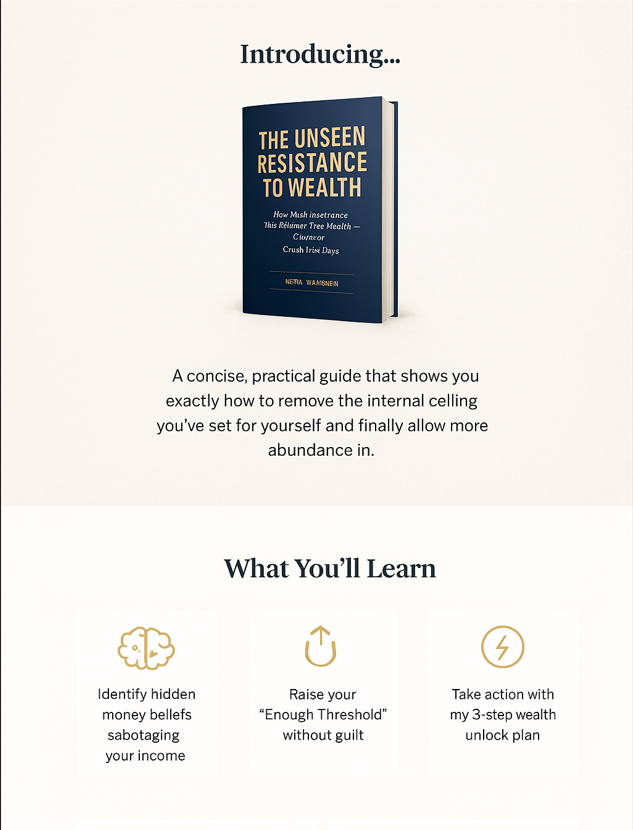
Brooke Davis, in his ebook “The Unseen Resistance to Wealth,” declares that it’s painful to admit this:
Wealth, Love, and an Amazing Relationship can approach you softly… and you will still turn away.
Because what you cannot emotionally hold, you subconsciously avoid.
The Question Beneath the Question
When someone asks whether to cut off their parents because of trauma inheritance, they are usually asking something else entirely: How do I stop feeling this way? How do I become someone whose past does not run their present?
Those are real questions. They deserve real answers. And the honest answer is that neither contact nor estrangement resolves them on its own. Both are containers. Neither is a cure.
Psychologist Joshua Coleman, who has researched estrangement extensively, notes that both generations operate under profoundly different assumptions about what love, repair, and responsibility require — and that reconciliation, when possible, has genuinely beneficial outcomes for both parties.
This does not mean you must reconcile. Some parents are not safe. Some patterns cannot be interrupted with the source still present. Some rooms you must leave to breathe.
But if you leave believing the leaving itself heals you, you will be disappointed. And you will be confused about why.
What to Do Before You Decide
Three questions worth sitting with, without rushing to answer:
Is the ongoing contact actively adding harm — or am I hoping that removing contact will remove pain that is already inside me?
Have I worked with a therapist who understands intergenerational trauma, not just relationship conflict? The tools for inherited trauma are specific. General talk therapy is not always sufficient.
Am I cutting off the person — or trying to cut off the pattern? Because the pattern does not leave with them.
Research consistently shows that trauma-focused psychotherapy — including Trauma-Focused Cognitive Behavioral Therapy and EMDR — shows promise in reversing some of the biological effects of intergenerational trauma, such as normalizing stress hormone levels and modulating epigenetic markers.
That is where the cycle actually breaks. Not in a blocked number. Not in a clean severance. In the slow, unglamorous work of becoming someone, the wound no longer runs.

Related articles:
Charisma, Character, and Personal Magnetism: Which One Do You Need?
Inside Out 2: Unlocking Levels of Consciousness
Would You Ask Your Worst Enemy for Help to Move Towards Your Goals?
7 Lessons from Wealthy People on Handling Failure with their Self-Concept
Julius Caesar's Magnetic Gaze: Power & Influence
Lazy but Ambitious: The Hidden Psychological Pattern Sabotaging Intelligent People
The Wealth Gap No One Talks About: Why Identity, Not Hard Work, Creates Millionaires
Why Your Self-Concept is Your Net Worth: The Hidden Psychology of Wealth Creation
How I Broke 13 Years of Money Blocks (And Why Most People Never Will)
theworld@inwithin.me
© 2025. All rights reserved.