Your Self-concept Generates Everything: Wealth, Abundance, Love, Relationships...
What If the People Who Left Were Not Leaving You — But Who They Can’t Control?
Rejoice, as toxic people are making space for high-level individuals to reach you by themselves. Will you feel guilty or grateful? Break the control cycle?
Tal
4/22/20263 min read


The story you told yourself about why they left was almost certainly wrong. Not because you were lying. Because grief doesn’t wait for clarity. It reaches for the nearest available explanation and holds on — and the nearest available explanation, almost always, is:
Something is wrong with me. I am not enough…
But what if the departure had nothing to do with your deficiency? What if it had everything to do with your expansion?
The Chemistry of Growth
Personal growth changes the chemistry of a relationship. This is not a metaphor. Research published in the Journal of Personality and Social Psychology found that consistent personal growth outside of a shared relational context is associated with lower romantic passion — not because the growing person becomes worse, but because the expanding self begins to occupy space the relationship was not built to hold.
When you start becoming more yourself — more honest, more boundaried, more aligned with what you actually want — the people around you are quietly asked to respond to someone they did not originally agree to know. Some respond by growing alongside you. Others find, without quite being able to say why, that the fit no longer works.
This is not betrayal. It is physics. Two things that once fit together no longer do — not because either of them broke, but because one of them changed shape.
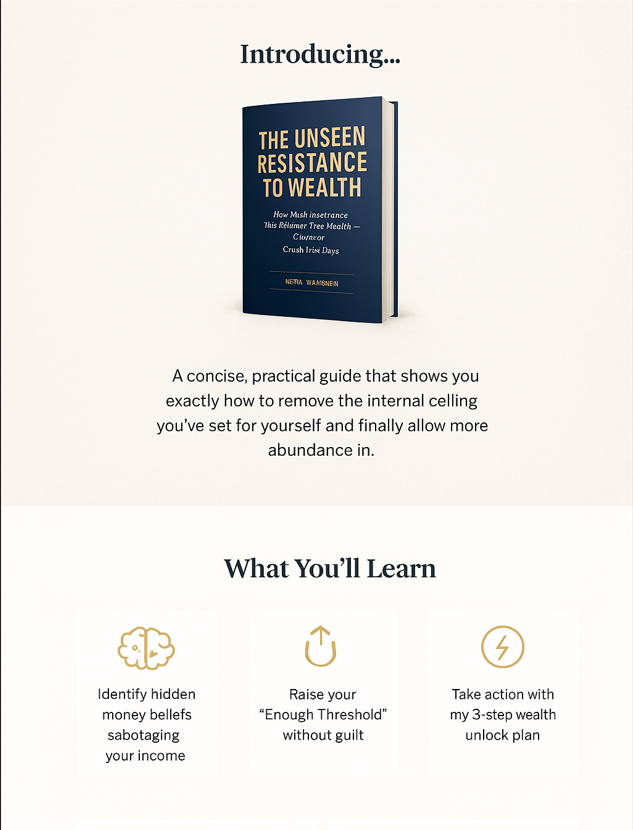
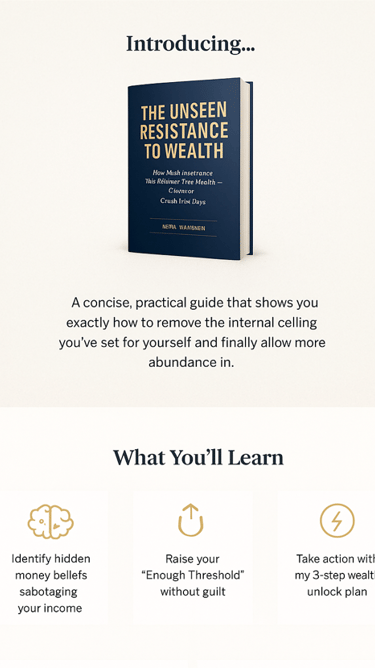
Do not wait for people to blackmail you emotionally because you are growing. Stay grounded in your identity at all times by discovering the mental and emotional weaknesses in you that they use in “The Unseen Resistance to Wealth” by Brooke Davis.
What Leaving Actually Signals
There is a particular quality to the relationships that cannot survive your growth. They tend to have been built on a very specific version of you — the version that was smaller, more accommodating, more available, more uncertain. The version that needed the relationship as much as the other person did, if not more.
When that version begins to recede, the relationship loses its architecture. There is nothing to hold the walls up anymore. And the person who was comfortable with the previous arrangement — who, it turns out, needed you to remain uncertain in order to feel secure — departs.
What they are leaving is not you. They are leaving is the version of you that would have stayed the same forever. And that version was, slowly and quietly, costing you everything.
The Grief Is Real and It Does Not Mean You Were Wrong
None of this makes the loss painless. Grief does not wait for understanding. The body does not distinguish between a departure caused by your failure and a departure caused by your growth. Loss is loss. The absence is the same absence.
But there is something important buried in that grief — if you can sit with it long enough without rushing to the familiar conclusion that you are the problem.
Research on personality change and well-being consistently finds that growth toward authenticity is associated with increased well-being, increased self-concept clarity, and stronger relationships — over time, not immediately. The transition is disorienting. The relationships that survive it are the ones worth surviving.
The ones that do not survive it were telling you something, too. They were showing you exactly how much of yourself you had to flatten, shrink, lessen to remain inside them.
The Reframe That Changes Everything
Most people experience the loss of a relationship during a period of personal growth as evidence that they went too far. That growth itself is dangerous.
The opposite is closer to the truth. The relationship did not end because you grew. It ended because it was built on the condition that you wouldn’t.
The people who leave as you expand are not evidence of failure. They are, in a strange way, your proof of progress. Their departure marks the perimeter of where the old you ended and the real one begins.
The question worth asking — quietly, honestly, after the grief has had its time — is not: Why did they leave?
It is: Who am I becoming that made staying impossible for them?
Because that person — the one whose emergence they could not accommodate — is exactly who you are supposed to be.
Always prepare for both: Growth and broken relationships. There is no one without the other.
Related articles:
Charisma, Character, and Personal Magnetism: Which One Do You Need?
Inside Out 2: Unlocking Levels of Consciousness
Would You Ask Your Worst Enemy for Help to Move Towards Your Goals?
7 Lessons from Wealthy People on Handling Failure with their Self-Concept
Julius Caesar's Magnetic Gaze: Power & Influence
Lazy but Ambitious: The Hidden Psychological Pattern Sabotaging Intelligent People
The Wealth Gap No One Talks About: Why Identity, Not Hard Work, Creates Millionaires
Why Your Self-Concept is Your Net Worth: The Hidden Psychology of Wealth Creation
How I Broke 13 Years of Money Blocks (And Why Most People Never Will)
theworld@inwithin.me
© 2025. All rights reserved.