Your Self-concept Generates Everything: Wealth, Abundance, Love, Relationships...
What Nobody Tells You About Loving Someone Who Cannot Receive Love
You have been offering love to someone who deflects it, dismisses it, or disappears when it gets too close. Psychology explains exactly what is happening — and what it is costing you.
Tal
5/20/20264 min read


You did everything right.
You were patient when they pulled away. You softened your approach when directness felt like too much. You learned their language, adjusted your timing, gave space when space was needed and stayed close when closeness seemed safe. You became, without quite deciding to, an expert in the specific art of loving someone carefully — measuring your warmth in doses small enough not to trigger the retreat you had learned to dread.
And still, somehow, the love never quite landed.
What nobody tells you is that this is not a communication problem. It is not a compatibility problem. It is not even, primarily, a problem with them. It is a nervous system problem — and understanding it clearly is the only thing that will stop you from spending another year trying to love someone out of an armor that was built long before you arrived.
Avoidant attachment doesn't heal through force. It develops when emotional needs were minimized, dismissed, or inconsistently met in early caregiving relationships — and avoidance isn't about a lack of feeling. It's about how closeness activates the threat system in the brain.
Read that again slowly. Closeness activates the threat system. When you move toward them with love — openly, genuinely, the way love is supposed to move — their nervous system does not register warmth. It registers danger. Not because you are dangerous. Because intimacy itself, encoded before they had language for it, became associated with pain, disappointment, or the particular withdrawal that follows vulnerability.
Individuals higher in attachment avoidance struggle to decode signals of love — they inaccurately perceive their partners' positive emotions, even during explicit expressions of love and affection. The love you are offering is not being received because it is not being accurately read. It passes through a perceptual filter that distorts warmth into threat, closeness into loss of autonomy, vulnerability into the specific danger of being seen and then left.
This is the thing nobody tells you: you can love someone completely and have that love consistently returned unopened. Not because they do not feel it. But because the internal architecture that would allow them to receive it was never built — or was dismantled early, by people who should have built it instead.
Here is what that does to the person on the other side.
The nervous system learns that love requires chasing, waiting, or earning through effort rather than receiving freely — and this early template shapes adult relationships, where emotional unavailability triggers familiar feelings of uncertainty and longing. You begin to work for the love that should arrive freely. You begin to measure your worth by how much warmth you can coax from someone who cannot offer it consistently. You mistake the occasional breakthrough — the rare moment they let you in — for proof that more effort will produce more access. It will not. The breakthrough was not a door opening. It was a window, briefly unlatched, before the lock clicked back.
The most important question is not how to love them better. You already know how to love them. The question is what loving them this way is costing the version of you that deserves to be loved back — fully, freely, without the daily recalibration of yourself to fit a space that keeps shrinking.
There is a pattern underneath this that extends beyond love. The same capacity that allows you to compress yourself for an emotionally unavailable partner is the same capacity that keeps you small in other areas of your life — financially, professionally, creatively. The tolerance for receiving less than you give does not stay in the relationship. It spreads.
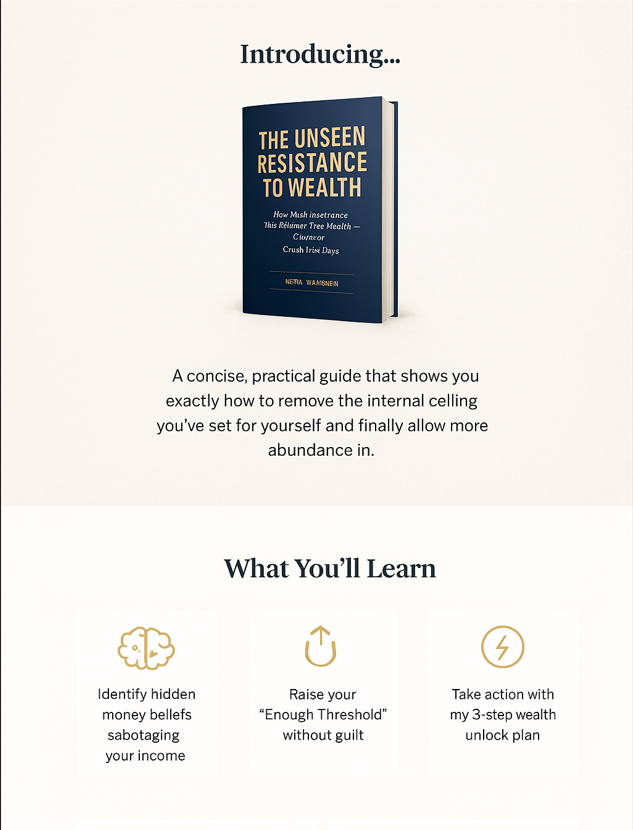
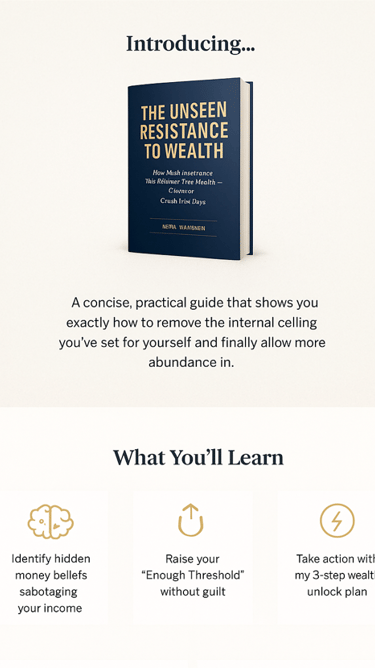
The Unseen Resistance To Wealth — How Much Is Too Much For You? addresses exactly this — the internal ceiling that decides, quietly and without your permission, how much good you are allowed to receive before you unconsciously return it. If you keep giving more than you receive — in love, in work, in life — this is the book that explains why. [Link]
Loving someone who cannot receive love is not a character flaw. It is a pattern. And like all patterns, it has a source — one that has far less to do with them than it does with what you learned, long ago, about what love is supposed to feel like when it is real.
Real love does not require this much translation. It does not ask you to become smaller to fit inside it. And it does not return your warmth unopened, year after year, while you stand at the door wondering what you are doing wrong.
You are not doing anything wrong. You are simply delivering mail to an address where no one has ever learned how to open the door.
Related articles:
Charisma, Character, and Personal Magnetism: Which One Do You Need?
Inside Out 2: Unlocking Levels of Consciousness
Would You Ask Your Worst Enemy for Help to Move Towards Your Goals?
7 Lessons from Wealthy People on Handling Failure with their Self-Concept
Julius Caesar's Magnetic Gaze: Power & Influence
Lazy but Ambitious: The Hidden Psychological Pattern Sabotaging Intelligent People
The Wealth Gap No One Talks About: Why Identity, Not Hard Work, Creates Millionaires
Why Your Self-Concept is Your Net Worth: The Hidden Psychology of Wealth Creation
How I Broke 13 Years of Money Blocks (And Why Most People Never Will)
theworld@inwithin.me
© 2025. All rights reserved.