Your Self-concept Generates Everything: Wealth, Abundance, Love, Relationships...

What Will Happen If You Spend Without a Budget? Is Frugality the Way to Financial Freedom?
Tal
4/28/2026


Most people believe their spending is roughly under control. They are wrong — and the error is not moral, it is neurological.
Research from the University of Virginia Darden School of Business identifies a phenomenon called expense prediction bias: most people dramatically underpredict their future spending, not because they are dishonest with themselves, but because the brain naturally surfaces typical, recurring expenses while systematically failing to account for contingencies. You remember the rent. You forget the car repair, the medical co-pay, the birthday dinner, the subscription you meant to cancel. It is not that people are trying to make optimistically low spending predictions — it is just how our brains work. It is easy to think of highly typical expenses, and hard to think of contingencies.
This cognitive blind spot, running unchecked without a budget, does not simply cause minor financial inconvenience. It compounds.
What Actually Happens When You Spend Without a Budget
The consequences of budgetless spending are not dramatic at first. They rarely announce themselves. They accumulate quietly, in the gap between what you think you spent and what you actually spent, month after month, until the gap becomes a wall.
Around three-quarters of Americans surveyed have an overspending problem, while more than half admit to spending recklessly. Almost half reveal they have cried over their spending habits. These are not people without income; some work in finance. Many earn reasonably well. The problem is structural: without a framework that forces you to confront your actual numbers before the money leaves your hands, spending decisions default to the emotional brain rather than the rational one.
The emotional brain makes purchases for three reasons: status, mood regulation, and the temporary silencing of anxiety. It buys the coffee because the morning feels hard. It upgrades the phone because the old one is a quiet source of shame. It books the trip because life lately has felt small. None of these impulses is inherently wrong. They become destructive only when they operate without accountability, in the absence of a plan or a long-term goal.
Trying not to spend is at odds with the emotions consumers experience in a tempting marketplace. Without a budget, there is no structure to absorb that tension. Every purchase decision becomes a fresh negotiation between desire and discipline, and desire has the home advantage.
The downstream consequences are not only financial. Research consistently links chronic financial stress to anxiety, impaired decision-making, and reduced cognitive bandwidth. The person who cannot predict their monthly outflows cannot meaningfully plan their future. They live in a permanent present tense — reactive, not strategic — and the compounding returns of investing, saving, and building wealth remain permanently out of reach.
Is Frugality the Answer?
The obvious prescription when spending is out of control is frugality. Spend less. Cut back. Live on less than you earn. And there is genuine power in this prescription — but also a serious limitation that the personal finance industry consistently underestimates.
Frugality, applied with intelligence and proportion, is one of the most legitimate tools available for building financial freedom. Its advantages are real and substantial.
It creates margin — the gap between income and expenditure that is the only raw material from which wealth can ever be built. There is no savings rate, no investment, no debt repayment without margin first. Frugality generates it deliberately rather than accidentally.
It builds the habit of intentionality. A person who has learned to question whether a purchase is necessary, valuable, or aligned with their actual goals has developed a cognitive capacity that pays dividends far beyond the money saved on any individual transaction.
It reduces financial anxiety at its root. When you spend less money, you naturally avoid debt, build a bigger savings pile, and otherwise build more financial security — all of which directly contribute to greater mental ease. The knowledge that you can live on less if necessary is itself a form of psychological wealth.
It accelerates the timeline to financial independence. Every percentage point increase in your savings rate is not just money saved — it is time purchased. The person saving 30% of their income reaches financial freedom decades earlier than the person saving 5%.
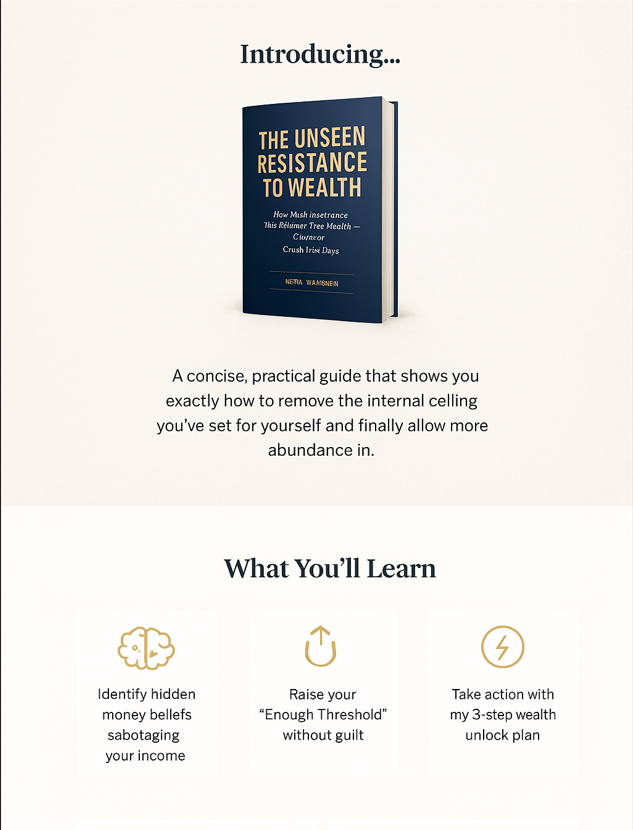
Spot the gap between the illusion of the mind and emotional triggers with this ebook, "The Unseen Resistance To Wealth" by Brooke Davis
The Hidden Costs of Frugality Before Financial Freedom
Here is where most financial writing goes silent, and where the honest analysis must begin.
Frugality before financial freedom is not the same as frugality after it. Before you have built a base of assets generating passive income, frugality operates under enormous psychological pressure. You are asking a person who has not yet won to play as though they already have something to protect. That pressure, sustained without relief, produces specific and well-documented failure modes.
The first is what researchers call the scarcity mindset — a psychological state in which chronic focus on what you cannot have narrows cognitive bandwidth, increases impulsivity, and paradoxically makes long-term financial planning harder. The mind under conditions of self-imposed deprivation begins to behave like the mind under genuine poverty: short-termist, reactive, and prone to occasional explosive overspending as the suppressed desire finally breaks through.
The second is the social and relational cost. Extreme frugality strains relationships. The person who will not contribute to a shared dinner, refuses to attend experiences that cost money, and treats every small expenditure as a moral failure becomes, slowly, someone people stop inviting. Isolation is expensive — not in money, but in the human capital, opportunity, and psychological resilience that social connection provides and that no savings account can replicate.
The third is the opportunity cost of under-investment in yourself. The American Psychiatric Association suggests that frugality can be a symptom of obsessive-compulsive personality disorder if taken too far. Too much frugality can even make you poorer — skipping the professional development course, refusing the mentor's dinner, delaying health care, and buying the cheapest version of everything are not savings. They are deferred costs with compounding interest.
The fourth is the misidentification of frugality as a wealth-building strategy. It is not. It is a wealth-preservation strategy. Frugality can protect what you earn. It cannot multiply it. The ceiling on how much you can cut is 100% of your expenses. The ceiling on how much you can earn is theoretically unlimited. A person who directs all their financial energy toward cutting rather than toward building income, investing, and developing skills has chosen the smaller game.
The Real Framework
The question is not whether there is a budget or no budget. The answer to that is unambiguous: a budget is non-negotiable before financial freedom, because without it, you are navigating blind in a marketplace designed to extract money from your unconscious impulses.
The real question is what kind of budget, and what kind of frugality. Budgets influence spending even when compliance is weak — meaning the act of setting a number, even an imperfect one, meaningfully constrains behavior. You do not need a perfect budget. You need an honest one.
And frugality, understood correctly, is not about deprivation. It is about alignment — the discipline of ensuring that where your money goes reflects what you actually value, rather than what the marketplace has trained you to reach for. Applied intelligently, it is a bridge. Applied as a permanent identity, it becomes a prison.
Financial freedom is not built by people who spend the least. It is built by people who knew precisely where every unit of their money was going, cut ruthlessly in areas that did not matter to them, and invested the difference with consistency and patience until the math began to work in their favor rather than against it.
The budget is not a restriction on your life. It is the first act of taking it seriously.
Related articles:
Charisma, Character, and Personal Magnetism: Which One Do You Need?
Inside Out 2: Unlocking Levels of Consciousness
Would You Ask Your Worst Enemy for Help to Move Towards Your Goals?
7 Lessons from Wealthy People on Handling Failure with their Self-Concept
Julius Caesar's Magnetic Gaze: Power & Influence
Lazy but Ambitious: The Hidden Psychological Pattern Sabotaging Intelligent People
The Wealth Gap No One Talks About: Why Identity, Not Hard Work, Creates Millionaires
Why Your Self-Concept is Your Net Worth: The Hidden Psychology of Wealth Creation
How I Broke 13 Years of Money Blocks (And Why Most People Never Will)
theworld@inwithin.me
© 2025. All rights reserved.