Your Self-concept Generates Everything: Wealth, Abundance, Love, Relationships...
Who Is Running Your Life Without Your Permission
The Advice You Give, the People You Love, the Enemies You Make. The life you build.
Tal
5/1/20264 min read


The Tiger, the lion, and the panther are harmless animals. Instead, chickens, geese, and ducks are highly dangerous animals, a worm said to his children-” Bertrand Russell.
The worm is not wrong. It is producing an accurate, internally consistent, and entirely derived from what the worm is. Not from what the world contains. From what the worm can reach, and what can reach the worm.
The advice you give. The people you trust. The dangers you see and the ones you miss entirely. The relationships you build and the ones you walk away from. The voices you hear as wise and the ones you dismiss as irrelevant — the love you recognize as love.
The Filter Nobody Tells You About
By the time you are aware of having a perception, your identity has already shaped what you are perceiving, which details are emphasized, which are suppressed, and what meaning the whole is assigned.
The person who believes they are fundamentally unlovable hears warmth as performance and criticism as confirmation. The person who believes they are fundamentally capable hears a challenge as an invitation and failure as information.
The person who believes the world is a fundamentally dangerous place reads neutral faces as hostile, ambiguous intentions as threatening, and other people’s success as a resource being extracted from a finite supply.
Who You Listen To — And Who You Cannot Hear
The quality of the advice does not determine the advice you take and the advice you dismiss. It is determined by whether the advice confirms or contradicts what you already believe about yourself.
People become invested in maintaining their self-views by obtaining self-confirming information.
The mentor who tells you that you are capable of more than you are currently attempting — if your self-concept says you are not, this advice does not land as encouragement. It lands as misunderstanding, as flattery, as evidence that this person does not really know you. You smile, you thank them, and you file the advice in the category of things that apply to other people.
Who You Love — And Who You Cannot
The same mechanism governs attraction, attachment, and the specific quality of love you are capable of receiving.
Why does the person who grew up with conditional love build relationships that replicate the condition? Why the person who believes at their core that they are too much keeps attracting people who eventually tell them exactly that.
You are not simply finding people. You are emitting a signal, and the signal is your self-concept, and the people who receive it most clearly are the ones whose relationship to you confirms what you already believe about yourself. The worm does not wander into tiger territory.
The Advice You Give — And What It Reveals
Here is the application of the Russell quote that people most rarely consider: the advice you give to others is not a neutral assessment of their situation. It is a projection of your self-concept onto their circumstances.
When someone comes to you with a problem, you do not analyze it from a position of pure objectivity. You analyze it through the lens of what you believe is possible, what you believe people deserve, what you believe about effort and courage, and the general relationship between action and outcome.
Every piece of advice you give is a window into your own self-concept — into what you believe, at the operating-system level, about how the world works and what people like you and them are entitled to expect from it.
The worm genuinely believes the duck is dangerous. It is not a performance concern. It is not being dishonest. It is giving the most accurate advice it can from the territory of its own experience — and that advice, handed to something that is not a worm, could be catastrophic.
Be aware of the advice you are receiving!
The most dangerous advice is the advice given with the deepest conviction — because conviction, in the domain of the self-concept, is not correlated with accuracy. It is correlated with how long the belief has been held unchallenged.
If wealth, amazing relationships…felt safe to you, you would already be closer to it.
Sometimes it’s right in front of you — obvious, reachable — but your nervous system rejects it before your logic can process it.
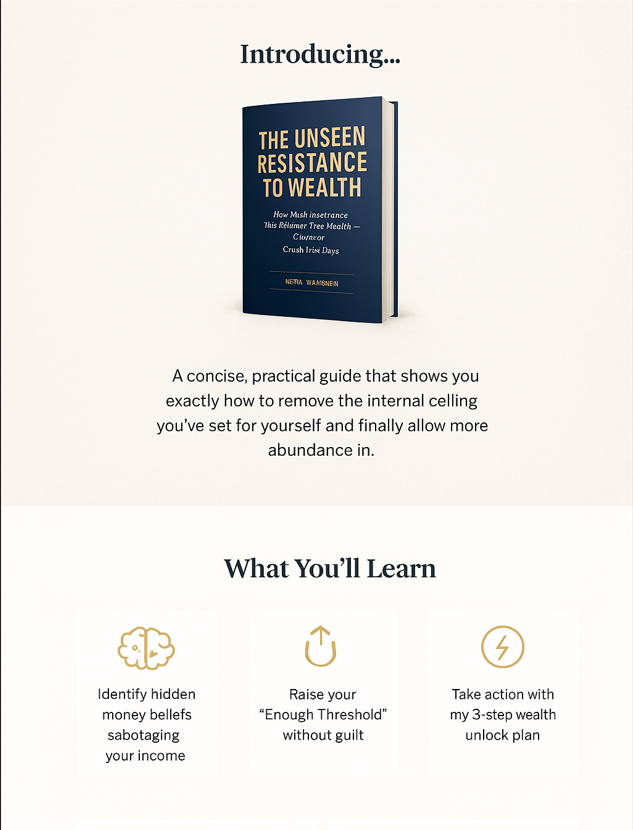
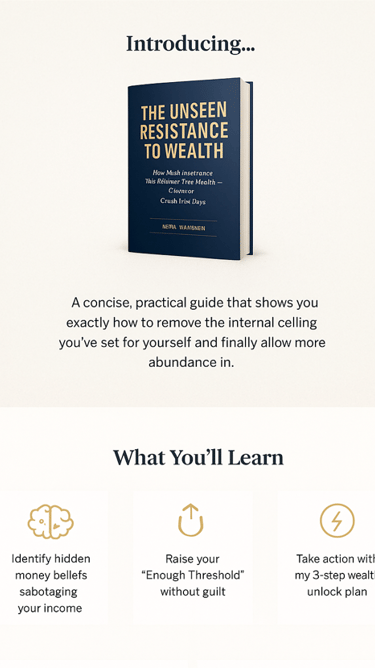
That’s identity at work. Dive deeper with “The Unseen Resistance To Wealth” by Brooke Davis
The Work That Changes Everything
What Russell’s worm cannot do is examine the ground it is standing on. It cannot step outside its own perceptual system and ask whether the threat map it is drawing matches the territory that actually exists.
It cannot interrogate the self that is generating the perceptions. It cannot choose to see differently.
You can !!!
The practical beginning is deceptively simple: when you notice a strong reaction — to a person, to advice, to a situation — pause before responding and ask not what is wrong with this but what does my strength of feeling reveal about what I believe about myself?
When someone’s success triggers you, that trigger is information about what your self-concept says you are allowed to have. When a piece of advice lands as threatening, that reaction is information about which of your self-beliefs it is contradicting. When you find yourself dismissing a person without quite being able to explain why, that dismissal is information about which kind of reflection they represent that your self-concept cannot currently accommodate.
Developing an accurate self-perception relies on how well we are capable of filtering and integrating information mirrored back to us by the external world. Every relationship, every reaction, every pattern of attraction and repulsion is showing you something about the lens through which you are looking.
The lens is not permanent. But it will not change by itself.
Related articles:
Charisma, Character, and Personal Magnetism: Which One Do You Need?
Inside Out 2: Unlocking Levels of Consciousness
Would You Ask Your Worst Enemy for Help to Move Towards Your Goals?
7 Lessons from Wealthy People on Handling Failure with their Self-Concept
Julius Caesar's Magnetic Gaze: Power & Influence
Lazy but Ambitious: The Hidden Psychological Pattern Sabotaging Intelligent People
The Wealth Gap No One Talks About: Why Identity, Not Hard Work, Creates Millionaires
Why Your Self-Concept is Your Net Worth: The Hidden Psychology of Wealth Creation
How I Broke 13 Years of Money Blocks (And Why Most People Never Will)
theworld@inwithin.me
© 2025. All rights reserved.