Your Self-concept Generates Everything: Wealth, Abundance, Love, Relationships...
Why Being "Frustration and Uncertainty Tolerant" Makes You a Narcissist But Extemely Powerful
Every powerful person throughout history has shared two qualities that nobody in your personal development feed is talking about simultaneously: an almost inhuman tolerance for frustration and uncertainty, and a complete, deliberate, sovereign shamelessness about what they want as a narcissist
Tal
3/19/20269 min read


Why Being "Frustration and Uncertainty Tolerant" Makes You a Narcissist
Why is this your best leverage and asset in any power dynamic?
The Dirty Secret of Every Power Structure Ever Built
Control has never been about strength.
Not physical strength. Not even intellectual superiority. The Roman Empire didn't dominate the known world through muscle. Wall Street doesn't extract wealth through brute force. Every power structure in human history — political, financial, relational, organizational — runs on one invisible fuel:
Other people's inability to tolerate discomfort
Every negotiation ever won was won by the person who needed the deal least. Every relationship dynamic ever dominated was dominated by whoever could tolerate the silence longest. Every market crash ever profited from was profited from by the person who could sit in uncertainty while everyone else was running for the exit.
Power does not go to the strongest.
Power flows — always, inevitably, without exception — to whoever can tolerate frustration and uncertainty the longest without flinching.
And here is where it gets deeply, disturbingly interesting.
The Neuroscience of Dominance Nobody Taught You
Your brain has a hierarchy.
At the bottom sits the amygdala; ancient, reactive, the neurological equivalent of a smoke alarm that cannot distinguish between a house fire and burnt toast. It governs fear, urgency, and reactivity. When it fires, you make desperate decisions. You accept bad deals. You speak when silence would have served you. You move when stillness was the power move.
Above it sits the prefrontal cortex, an evolutionary masterpiece, the seat of strategy, patience, and long-range vision. This is the part of your brain that can hold uncertainty without collapsing into it. That can feel frustrating without becoming it.
Here is what neuroscience reveals: individuals with high frustration tolerance show measurably higher activity in the prefrontal cortex during high-stakes interactions, and measurably lower cortisol responses during conflict.
Translation: they are literally operating from a different, more powerful brain state than everyone around them.
They are not just psychologically stronger.
They are neurologically dominant.
And the people across the table from them — the ones whose amygdala are firing, whose cortisol is spiking, whose need for resolution is becoming desperation — can feel it.
They just don't know what they're feeling.
Why This Makes You a Narcissist And Why That's Not What You Think
The clinical definition of narcissism includes one characteristic that gets almost no attention in the pop psychology version everyone loves to throw at their ex-partners:
Reduced emotional reactivity in high-stress interpersonal situations.
The narcissist — the genuinely powerful, structurally dangerous kind, not the Instagram diagnosis — is not more emotional than you. They are less emotionally reactive. They can sit in a conversation that would shatter most people and feel almost nothing. They can tolerate your frustration, your silence, your withdrawal, your anger, and simply wait.
Result: They can accommodate all sorts of people and points of view without judgment. For instance, the South Carolina senator Lindsey Graham, who said horrible things about Donald Trump, became his biggest Acolyte. His answer to the journalist was even more fascinating: "He is the President of the United States of America, whether I like him or not, I will need him on my side if I want legislation to pass in my state.
While you spiral, they strategize.
While you need resolution, they need nothing.
While you reveal your position through your reaction, they reveal nothing.
This is why they win. Not because they're smarter. Not because they're better. Because emotional neediness is the most readable tell in any power dynamic — and they have none.
Now. Here is the question that should be keeping you awake tonight.
What if you cultivated that same tolerance — not from a wound, not from emptiness, not from the absence of feeling — but from an abundance so deep that urgency simply has nowhere to land?
What if the most powerful version of you wasn't cold? What if it were full?
Every Powerful Person Is Shameless. Here's What That Actually Means.
This is the concept that unlocks everything else.
Shame is the most sophisticated leash ever invented.
It does not need a lock. It does not need a guard. It does not need external enforcement of any kind. It lives inside you — installed by childhood, culture, religion, comparison, and every moment someone made you feel that wanting more was greedy, that being seen was arrogant, that taking up space was offensive, that needing help was weakness.
And it works perfectly.
Because a person who carries shame cannot hold power, not sovereign, lasting, wealth-generating, room-commanding power. They can perform it temporarily. But the moment the stakes rise, the moment the negotiation gets uncomfortable, the price gets challenged, the vision gets questioned, shame whispers, "Who do you think you are?"
And they fold, every single time.
Now study the people who don't fold.
Study the negotiator who names their price and sits in silence while the other side squirms. The entrepreneur who pitches the same vision after ten rejections with the same conviction as the first time. The leader who asks for what they need from anyone — ally or adversary — without apology or explanation.
What do they share? Not talent. Not luck. Not superior intelligence.
Shamelessness.
Not the reckless, boundary-violating shamelessness of someone who has never developed a conscience. But the sovereign, deliberate shamelessness of someone who has looked at every desire, every ambition, every need — and decided, without requiring anyone's permission, that they are allowed to want it.
That they are allowed to ask for it. That they are allowed to pursue it publicly, imperfectly, repeatedly, and without apology.
Brooke Davis discovered this at the core of every money block he identified. Underneath the unworthiness, the fear of being seen, the bargaining, the pride, the denial, was always the same root:
Shame about wanting.
Shame that whispered too much. Shame that said not you. Shame that made the dream feel like evidence of delusion rather than direction.
And it cost him nine years.
The shameless person is not without values. They are without the need for external permission to live by themselves. They have completed the internal audit — examined their desires, claimed them as legitimate, and decided that the discomfort of others with their ambition is not their responsibility to manage.
This is not narcissism in the clinical sense. This is sovereignty in the truest sense.
The Difference Between Wounded Dominance and Sovereign Power
This is the distinction that separates the narcissist from the master.
The narcissist tolerates frustration because they feel nothing deeply. Their emotional flatness is a symptom of emptiness — a void dressed as strength, a wound performing as confidence. They do not need resolution because they do not genuinely desire connection. They are not tolerating discomfort. They simply do not feel it.
Their shamelessness is not freedom. It is damaged. That is not power. That is damage to wearing the power's clothes.
Sovereign power is different.
Sovereign power is the person who feels everything — every volt of frustration, every wave of uncertainty, every pull of urgency, every flicker of shame — and chooses, from a place of deep internal abundance, not to be governed by any of it.
They are not numb. They are rooted. They are not cold. They are still.
They are not shameless because they feel nothing. They are shameless because they have decided their desires are legitimate — and that decision is not available for renegotiation.
They do not need the deal because they know another is coming. They do not need the validation because their self-concept does not require external confirmation. They do not collapse into the silence because their worth is not stored in the other person's response.
This is what Brooke Davis calls self-worth integration — the state where your value is no longer tied to outcomes, reactions, or the speed at which the universe responds to your desires.
And it is the single most powerful asset you can bring into any room, any negotiation, any relationship, any power dynamic on earth.
Five Ways to Build the Most Dangerous Calm and the Most Liberating Shamelessness in Any Room
1. Manufacture voluntary discomfort daily. Cold exposure. Hard conversations you've been postponing. The ask you've been afraid to make. Every time you deliberately choose discomfort, you expand your frustration tolerance by training your nervous system that discomfort does not equal danger. The amygdala quiets. The prefrontal cortex strengthens. You become, physiologically, harder to destabilize.
2. Audit your shame inventory. Write down every desire you have been embarrassed to admit — to yourself, let alone out loud. The income level. The lifestyle. The relationship. The recognition. Every single one. Then ask with ruthless honesty: whose voice told me this was too much? Name it. Date it. And then fire it. You did not choose that voice. You do not have to keep it employed.
3. Practice the power pause. In every high-stakes interaction — negotiation, conflict, confrontation — introduce a pause before responding. Three seconds. Five. Ten. This single habit simultaneously activates your prefrontal cortex, deactivates your amygdala, and signals to every nervous system in the room that you are not reactive. That you are not desperate. That you are operating on a timeline nobody else controls.
4. Detach your self-concept from outcomes. The moment your identity requires a specific result to remain intact, you have handed your power to whoever controls that result. Practice making decisions from identity, not from need. Not "I need this to work" but "this is who I am and what I do — the outcome is the universe's department." This is not spiritual bypassing. This is the most sophisticated negotiating position available to a human being.
5. Let them need it more. In any dynamic — business, romantic, social — the person with the most options and the least urgency holds the power. Stop manufacturing urgency that doesn't exist. Stop filling silence with nervous energy. Stop explaining, justifying, and over-communicating your value. Your stillness is the communication. Your patience is the power move. Your shameless, unapologetic presence is the signal that changes the room. Let them need the resolution. Let them break the silence. Let them come to you.
The World Has Always BelongED to the Unrushed and the Unashamed
Napoleon studied it. Churchill embodied it. Every great negotiator, every transformational leader, every person who has ever moved a room without raising their voice, understood two fundamental truths about power:
Whoever controls their internal state controls the external dynamic.
And whoever has released their shame controls their internal state.
Not the loudest person. Not the most aggressive. Not even the most intelligent. The most regulated. The most rooted. The most sovereign. The most shameless in their pursuit of the life they were built for.
You have been told your frustration is weakness. That your uncertainty is inadequacy. That your ambition is arrogance. That wanting more than you currently have is ingratitude. The discomfort you feel when things don't move at the pace you need them to is evidence that you don't have what it takes.
Those are not truths. They are leashes, designed to keep the manageable manageable and the powerful powerful.
And they work on everyone who never questions them.
This Is Where Your Wealth Blocks Live
Here is the connection nobody makes.
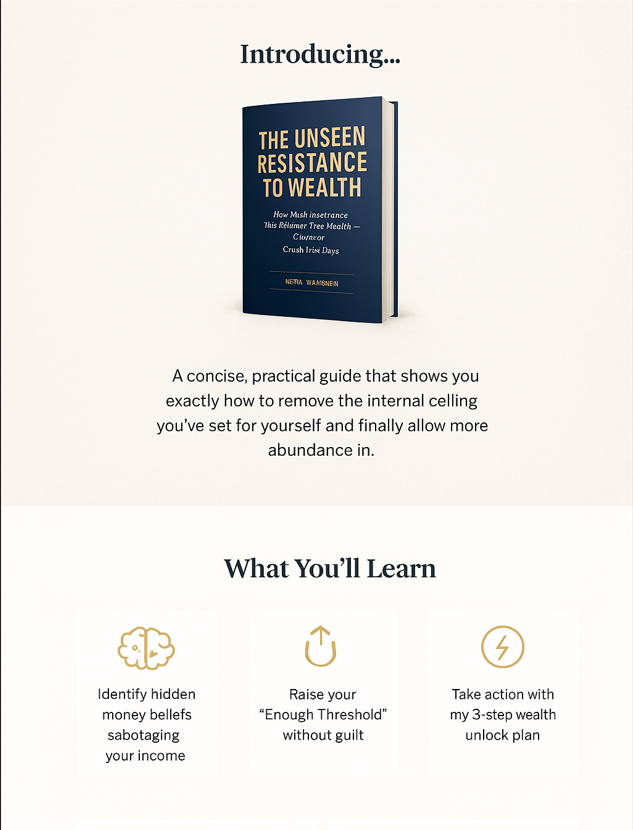
Every money block Brooke Davis identifies in The Unseen Resistance to Wealth — the unworthiness, the fear of being seen, the bargaining, the identity conflict, the subbing to money — shares one root system.
Shame and low frustration tolerance.
The inability to sit in the discomfort of wanting without having. The inability to hold the tension between where you are and where you desire to be without collapsing the gap prematurely. The inability to want wealth, love, recognition, and freedom loudly, proudly, and without apology — because somewhere along the way someone made you feel that wanting was the problem.
Wealth — real, lasting, sovereign wealth — requires you to hold a vision in one hand and uncertainty in the other, walk forward anyway, and be completely, radically, almost offensively unashamed of where you are going.
For months. Sometimes years. Without the deal closing, without the validation arriving, without the universe confirming your timeline.
The people who do this are not special. They are not lucky. They are not more talented than you.
They are simply shameless about their destination — and sovereign enough in their nervous system to enjoy the journey without needing it to end on their schedule.
That combination — shamelessness plus frustration tolerance — is not a personality trait. It is a practice, and it is available to you.
Starting today. Starting with one deliberate, uncomfortable, power-building, shame-dissolving move that every conditioned part of you will resist with everything it has.
Make it anyway.
Related articles:
Charisma, Character, and Personal Magnetism: Which One Do You Need?
Inside Out 2: Unlocking Levels of Consciousness
Would You Ask Your Worst Enemy for Help to Move Towards Your Goals?
7 Lessons from Wealthy People on Handling Failure with their Self-Concept
Julius Caesar's Magnetic Gaze: Power & Influence
Lazy but Ambitious: The Hidden Psychological Pattern Sabotaging Intelligent People
The Wealth Gap No One Talks About: Why Identity, Not Hard Work, Creates Millionaires
Why Your Self-Concept is Your Net Worth: The Hidden Psychology of Wealth Creation
How I Broke 13 Years of Money Blocks (And Why Most People Never Will)
theworld@inwithin.me
© 2025. All rights reserved.