Your Self-concept Generates Everything: Wealth, Abundance, Love, Relationships...
Why Compliments Make You More Anxious Than Criticism The Burden of Doing Well: Why Praise Feels Like a Threat
Being told you're doing well should feel good. For many people, it doesn't — it triggers a quiet, specific dread. This isn't a weakness. It's psychology. Here's the science behind why praise worries you more than criticism ever could.
Tal
4/3/20264 min read


You pass the milestone. Someone notices and says the words — you’re doing well — and instead of relief, something tightens. Your mind doesn’t rest, but accelerates.
This is not gratitude. This is the particular, private panic of a raised bar.
The Statistic That Changes the Conversation
Most people assume anxiety flows in one direction — downward, toward failure and criticism. The science says otherwise.
Research published in the journal Depression and Anxiety (2025) found that individuals with social anxiety experience fear of both negative and positive evaluations — and that positive evaluations trigger worry not despite their pleasantness, but because of it. Praise signals upward social mobility, attracting competitive attention and challenges from peers.
In other words, being seen as doing well makes you a target.
Around 70% of adults experience Impostor Syndrome at least once in their lifetime. Among high achievers, 25 to 30 percent suffer from it persistently. These are not people who struggle. They are people who succeed — and are haunted by it.
What Praise Actually Does to the Anxious Mind
When someone tells you that you are doing well, four things happen almost simultaneously — and none of them are conscious.
First, your brain registers a new baseline. The compliment does not land as an affirmation. It lands as a new standard. You were not doing this well before, which means you were acceptable before, which means you now must sustain what you were not previously required to sustain.
Second, the expectation gap widens. Research confirms that people with Impostor Syndrome are linked with fear and worry as well as anxiety and guilt in response to praise or achievement — not because they disbelieve the praise, but because they believe the next failure will be more visible, more consequential, and more shameful.
Third, the attribution collapses inward. People with Impostor Syndrome attribute their successes to external factors such as luck or good timing — meaning when they are told they are doing well, they do not hear “you earned this.” They hear, “You got away with something, and now more people are watching.”
Fourth, the bar moves. Research shows that fear of success is directly linked to the worry that success will result in others raising their expectations — that a promotion leads to more responsibility, which increases the probability of being exposed as a fraud.
The praise is not the problem. The praise is the announcement that the stakes just increased.
The Deeper Root: Why Praise Was Never Safe
This pattern does not begin in adulthood. It begins in the family system.
Two types of messages spark Impostor Syndrome in children: constant criticism, which makes them feel they will never be enough, and superlative praise — “You’re the smartest!” — which instills pressure so high that failure becomes catastrophic.
Consider someone raised in a home where excellence was required, not celebrated. Praise in that environment was not a landing place. It was a launching pad — the beginning of a higher expectation, a sharper measure, a shorter leash. The child learned, correctly, that being told you are doing well is the moment your slack runs out.
That child grows up. The environment changes, but the lesson does not.
The Real Name for This
Psychology calls it Fear of Positive Evaluation. It functions as a protective mechanism: by avoiding leaving a “too good” impression, the person shields themselves from the competitive pressure that upward social mobility creates. Fear of Positive Evaluation and the more familiar Fear of Negative Evaluation operate together. One, keeping you from falling too far, the other from rising too visibly.
The result is a person suspended between two anxieties, unable to fully occupy either failure or success without dread.
This is not fragility. It is a coherent, self-protective architecture built over the years. The architecture works — it keeps you safe from the specific pain it was built to prevent. The cost is that it also keeps you from ever fully arriving anywhere.
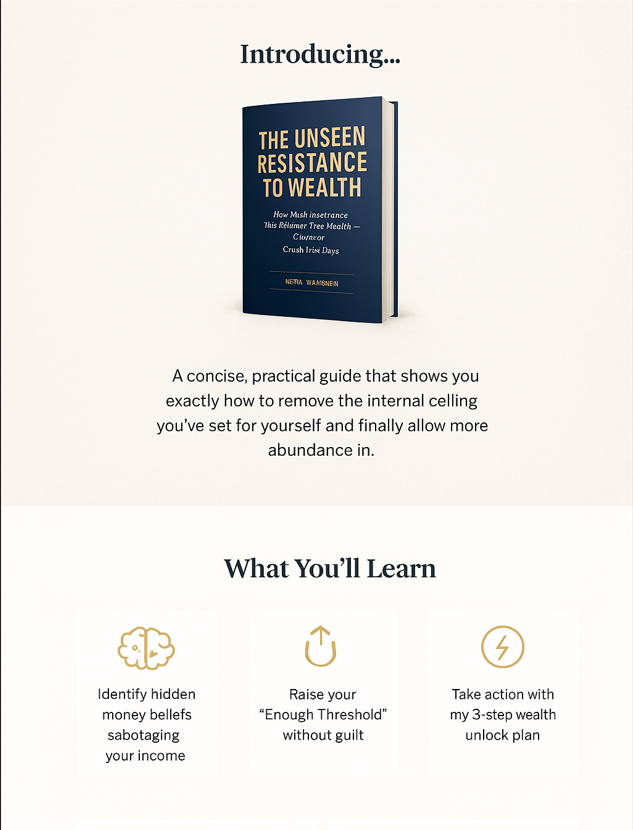
How many of these mental illusions are keeping you poor and from fulfilling your potential? We live in a wealthy world. Money moves every second. Opportunities multiply. People less intelligent than you are expanding daily. And yet…
You wake up feeling behind, watching, waiting.
It’s not because wealth isn’t available, but you’re not calibrated to see it.
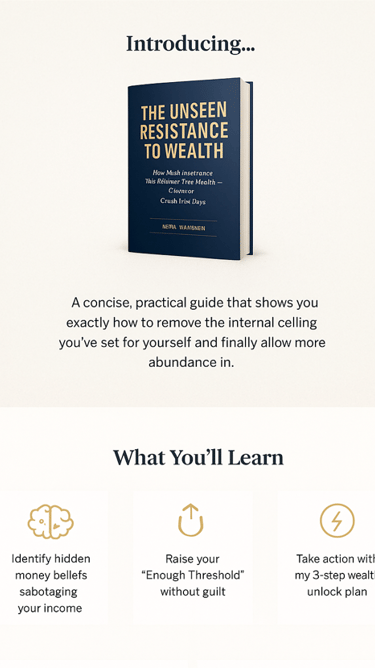
This book, “The Unseen Resistance to Wealth,” By the Psychologist Booke Davis, doesn’t give you money.
It removes the blindfold
What to Do With This
The worry when praised is information. It tells you precisely where your self-worth is not yet self-sourced — where it still lives, contingently, in what other people expect next.
The question is not “How do I stop worrying when praised?” That is the wrong frame. The question is: “What would I have to believe about myself for praise to be receivable — not as a raised bar, but as evidence?”
That question is uncomfortable. It is also the only one worth sitting with.
Being told you are doing well should not feel like a warning. That it does is not a flaw. It is a map. And maps are only useful if you are willing to read them.
Related articles:
Charisma, Character, and Personal Magnetism: Which One Do You Need?
Inside Out 2: Unlocking Levels of Consciousness
Would You Ask Your Worst Enemy for Help to Move Towards Your Goals?
7 Lessons from Wealthy People on Handling Failure with their Self-Concept
Julius Caesar's Magnetic Gaze: Power & Influence
Lazy but Ambitious: The Hidden Psychological Pattern Sabotaging Intelligent People
The Wealth Gap No One Talks About: Why Identity, Not Hard Work, Creates Millionaires
Why Your Self-Concept is Your Net Worth: The Hidden Psychology of Wealth Creation
How I Broke 13 Years of Money Blocks (And Why Most People Never Will)
theworld@inwithin.me
© 2025. All rights reserved.